Fluorescence in Non-Destructive Testing: Technology that Amplifies Results
In industrial inspection, fluorescence in non-destructive testing (END) is a technology that significantly enhances sensitivity and visual accuracy.
Applied in methods such as Liquid Penetrant (LP), Magnetic Particle (MP), and Leak Detection (DV), this technique allows for the identification of minute discontinuities and micro-leaks invisible to the naked eye. The result is greater safety, reliability, and operational performance.
What is fluorescence?
Fluorescence is an optical phenomenon in which certain substances absorb energy from ultraviolet (UV-A) light and re-emit it in the form of visible light .
In non-destructive testing (END), this physical principle is used to enhance the contrast of indications on metallic and non-metallic parts, facilitating the identification of surface or subsurface defects .
When UV-A light (365 nm) strikes the inspected material, the fluorescent particles or dyes react by emitting intense light—typically in shades of green, yellow, or orange. This makes discontinuities clearly visible, even in hard-to-reach areas.
The result is a highly sensitive, precise, and visually clear test that allows for quick and reliable decisions.
Applications of fluorescence in END methods
1. Liquid Penetrant Testing (LP)
The LP fluorescent (Type I) method is indicated for detecting surface-open discontinuities, such as cracks, pores, lack of fusion, and other defects that may compromise the integrity of a component.
After cleaning and applying the penetrant, the excess is removed and the developer is applied. Under UV-A light, the remaining liquid in the discontinuities emits intense fluorescence, clearly revealing the indications.
Among the main advantages is its versatility of application.
The method can be used on metallic and non-metallic materials, whether magnetic or non-magnetic, such as aluminum, magnesium, austenitic stainless steels, and titanium.
It can also be applied to ceramics, glass, and some types of plastics, provided they are non-porous materials.
Metal-Chek Products:
- FP-91 and FP-91 HI – Water-washable penetrants, Type I – Method A, Level 2, ideal for inspections requiring greater sensitivity.
Compatible with D70, D72 and D702 developers.
2. Magnetic Particle Testing (MPT)
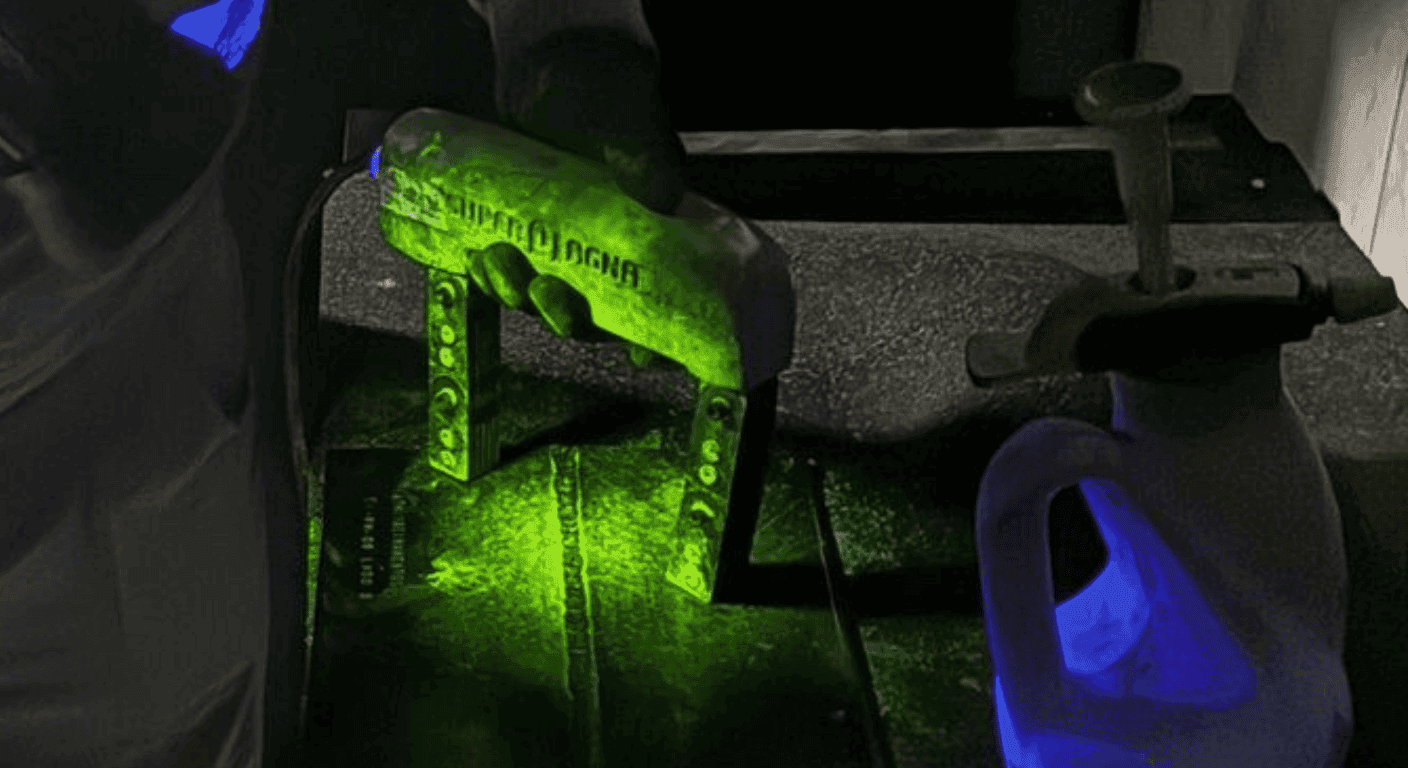
In ferromagnetic materials, fluorescence enhances the detection of surface and subsurface discontinuities. Fluorescent magnetic particles
accumulate in regions where the magnetic field escapes, forming visible indications under UV-A light. For magnetic particle testing to be effective, it is essential that the part be magnetized. The application of a magnetic field —circular, longitudinal, or combined—creates magnetic flux lines in the material.
Metal-Chek offers the Supermagna Yoke HMM6, an alternating current (AC) electromagnetic yoke developed for visible and fluorescent testing. The equipment provides a stable magnetic field and high mobility, making it widely used in industrial, petrochemical, and predictive maintenance inspections.
Metal-Chek Products:
- Supermagna LY 800 – High-sensitivity fluorescent dry-process magnetic particle.
- Supermagna LY 2000, LY 2000 V, LY 3000 and LY 3000 V – Wet-applied fluorescent magnetic powder particles, applicable with OMC 10 MMS (oil) or BC 502 SN + water vehicles.
- Supermagna CLY 2000 VO MMS BP / CLY 3000 O MMS BP / VO MMS BP – Ready-to-use wet (oil) baths with high mobility and contrast.
- Supermagna DLY 2000 – Water-dispersible wet magnetic particle.
- Supermagna CRL 265 AG/SN – Dual concentrate (fluorescent/visible), applicable under visible (white) or UV-A light in environments up to 1000 lx.
3. Leak Detection (Leak Testing)
In leak tests, fluorescent additives allow visualization of micro-leaks in hydraulic, pneumatic, and lubrication systems.
Under UV-A light, even the smallest leaks become visible, enabling immediate repairs and preventing critical failures.
Metal-Chek Products:
- Oil-Glo Ultra SPI Series
- SPI-OGG (Green) , SPI-OGB (Blue) and SPI-OGW (White) — Fluorescent detectors for oily fluids.
- Non-flammable, they do not alter the properties of fluids and are NSF certified .
- Water-Glo Ultra SPI Series – Green (WGG) and blue (WGB) fluorescent dyes for aqueous systems.
UV-A Lighting Equipment
For fluorescent testing, it is essential to use UV-A (365 nm) light sources with a minimum intensity of 1000 µW/cm² on the surface being examined, in accordance with END technical standards.
This intensity ensures adequate contrast and accurate reading of the indications.
Benefits of fluorescence in END
The correct application of fluorescence brings significant technical advantages:
- High visual sensitivity , revealing minute discontinuities.
- Greater contrast and clarity of the indications.
- Safe and versatile application in different methods and materials.
- Technical compliance with national and international standards.
- Reduction of rework and operational errors.
Furthermore, fluorescence improves the reliability of results and strengthens quality control in critical inspections.
Fluorescence in non-destructive testing is an essential technology that raises the standard of precision, safety, and reliability in industrial inspections.
By applying this technique in liquid penetrant testing (LP), mechanical testing (PM), and visual diffusion (DV), enhanced visualization, high sensitivity, and immediate results are obtained, reducing failures and ensuring operational reliability.
With the complete Metal-Chek product line — which includes penetrants and fluorescent particles, leak detection additives, magnetization equipment, and UV-A illumination — your industrial inspection reaches new levels of quality and technical compliance.
See beyond the visible — Metal-Chek fluorescent technology.
Solutions for Non-Destructive Testing.
Talk to our experts
and follow us on @metalchek
