Archives November 2025

Care and Storage and Expiration Dates of END Consumables

In industrial settings, consumables for Non-Destructive Testing (END) are true allies of reliability. Penetrant liquids, magnetic particles, and developers are formulated to deliver sensitivity , contrast, and stability —three pillars that support the precision of inspections.

One critical point that cannot be overlooked: storage . When done improperly, it accelerates product degradation and directly compromises the test results.

And in industrial inspection, a mistake never comes alone — it translates into rework, costs, and risks.

Therefore, taking care of expiration dates and storage conditions is not just a good practice:  it is fundamental to maintaining the performance and technical compliance required in industrial inspections.

Why proper storage is essential

END consumables undergo rigorous formulations, developed to maintain their properties throughout use. However, factors such as humidity, temperature, and expiration date can compromise them.

  • sensitivity in detecting discontinuities,
  • contrast of the indications,
  • chemical stability
  • Repeatability of results .

When exposed to unsuitable conditions, they may:

  • to crowd together,
  • evaporate,
  • change color, odor or viscosity,
  • lose sensitivity,
  • to generate false indications or mask real flaws.

A degraded product can alter the test results.

Effects of moisture on END consumables

Moisture is one of the main factors that affect the quality of consumables.
When present in excess, it can cause clumping of powdered consumables, changes in product characteristics,  affecting performance and sensitivity.

To avoid these effects, it is important to store the products in dry, well-ventilated places , protected from condensation and sudden temperature changes. In addition, it is recommended to keep the packaging tightly closed , especially in environments with high relative humidity.

Temperature and chemical stability

Temperature has a direct impact on the chemical stability of END consumables. Excessive heat
can alter pigments, cause the evaporation of volatile components, and compromise the performance of penetrants, developers, and magnetic suspensions.
Extreme cold, on the other hand, can cause the crystallization of components , rendering the product unusable.

To ensure optimal stability and sensitivity, it is recommended to store consumables as follows:

  • In cool environments , with controlled temperatures between 5°C and 40°C;
  • Keep away from heat sources, direct sunlight, and open flames;
  • Avoid prolonged exposure to temperature variations.

Validity and usage control

Each consumable has an expiration date defined by the manufacturer , which must be strictly respected.
After this period, there is no guarantee of stability or performance — the product may show changes in color, odor, viscosity, or the formation of residues, indicating degradation of the active components.

In addition to the expiration date, it’s important to check:

  • Storage conditions ;
  • Label integrity and batch identification .

Good practice includes using the FIFO (first in, first out) principle , ensuring that older products are consumed before new ones.

Good storage practices

  1. Store upright to prevent leaks or deformation of the packaging.
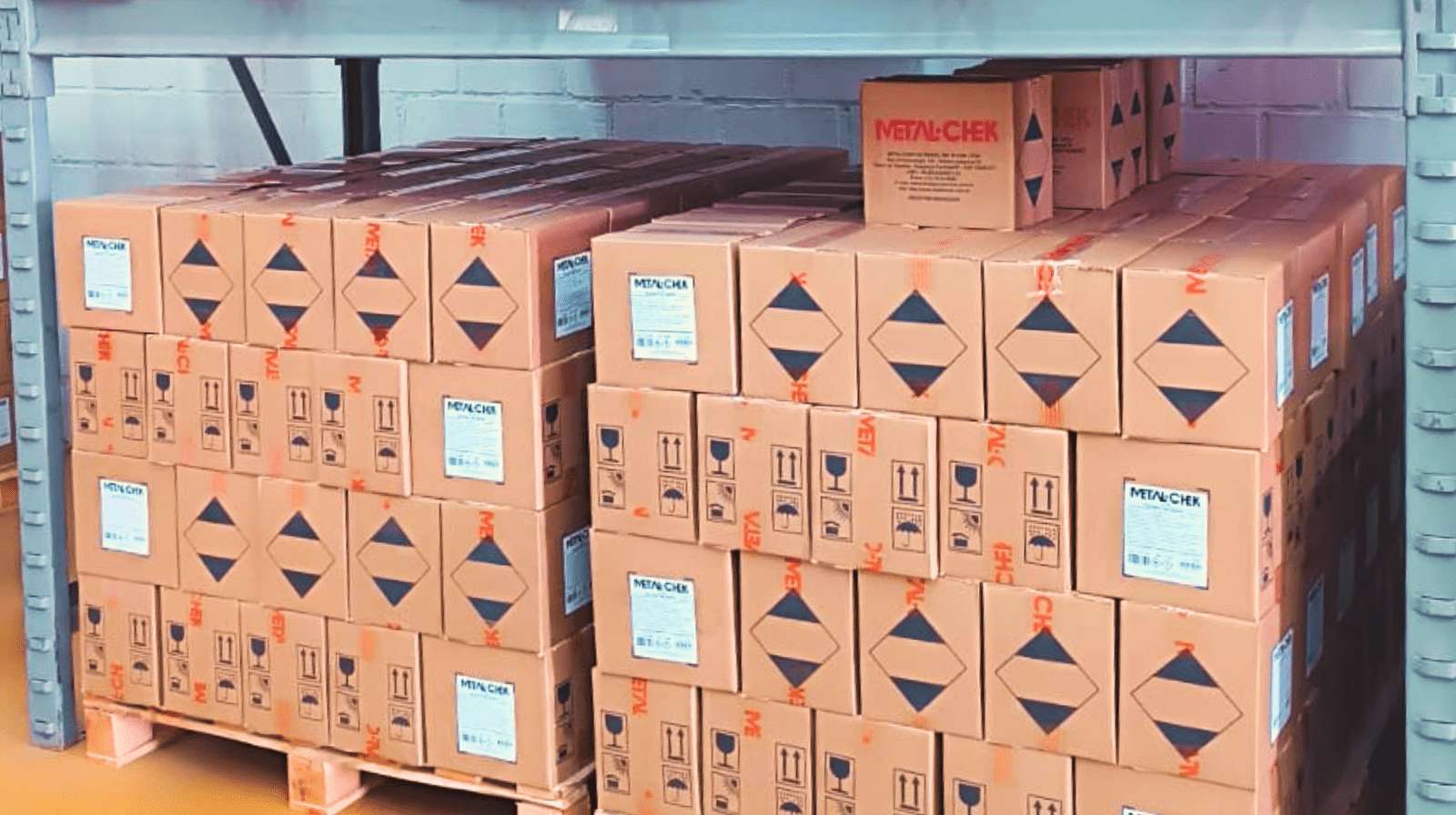
  2. Avoid stacking cans or aerosols to prevent pressure damage.
  3. Keep the products sealed until the moment of use.
  4. Do not mix products from different manufacturers — chemical compatibility is not guaranteed.
  5. Visually inspect the product before use: changes in appearance indicate loss of stability.
  6. Use appropriate storage methods , keeping them away from electrical sources and intense heat.

These measures help preserve the original characteristics of END consumables and ensure testing with maximum repeatability and reliability.

Why follow these guidelines?

Following good storage and expiration date control practices reduces costs, avoids rework, and ensures the integrity of inspection results .
Proper preservation of END consumables is an essential part of quality management in industrial inspections , ensuring that each application maintains the expected performance standard from the first to the last use.


Properly storing and controlling END consumables is an investment in reliability, safety, and durability .
By maintaining ideal temperature, humidity, and shelf-life conditions, inspection ensures consistent results that comply with industry technical requirements.

The inspection begins long before the test is performed — it begins in the warehouse.


Metal-Chek provides complete solutions for Non-Destructive Testing: penetrant liquids, magnetic particles, developers and accessories , developed with cutting-edge technology to offer safety, precision and reliable results in every inspection.

○ Need technical support? Our Metal-Chek consultants are ready to help.

○ Keep learning: explore more technical articles about END on our blog .

○ Join the community of END inspectors and professionals — follow @metalchek .
Chemical Compatibility in Non-Destructive Testing (END)

The reliability of results in Non-Destructive Testing (END) depends directly on the chemical compatibility between the products used. Mixing penetrant liquids, removers, and developers from different manufacturers can compromise sensitivity, generate reading errors, and even invalidate the test.

To ensure consistent performance, traceability, and chemical stability at all stages, it is essential to use complete systems from a single manufacturer—such as the Metal-Chek line—always strictly following the manufacturer’s technical guidelines and applicable procedures.

The Importance of Chemical Compatibility in Non-Destructive Testing

In Non-Destructive Testing (END) , product compatibility is one of the most critical factors in ensuring accurate results.
In methods such as Liquid Penetrant Testing (LP) , each step— pre-cleaning, penetration, removal, and development —depends on a specific and controlled chemical formulation.

Mixing products from different manufacturers, even within the same category, can directly impact the sensitivity of the assay.

All materials used in an assay must be chemically compatible and, preferably, from the same manufacturer .
This standardization ensures the traceability , repeatability , and reliability of the results , as well as guaranteeing that the assembly was developed and tested to operate in chemical equilibrium under controlled conditions.

Risks of Mixing Different Products in Non-Destructive Testing

The use of penetrating fluids, removers, and developers of different brands or chemical compositions compromises the integrity of the process.
Among the main risks are:

  • Loss of contrast between the background and the indications;
  • Improper removal of the penetrant during cleaning;
  • Unexpected chemical reactions between solvents, pigments, and additives;
  • Forming false indications in reading;

These factors can lead to false results , rework, and delays, as well as jeopardize the reliability of the inspection and operational safety.

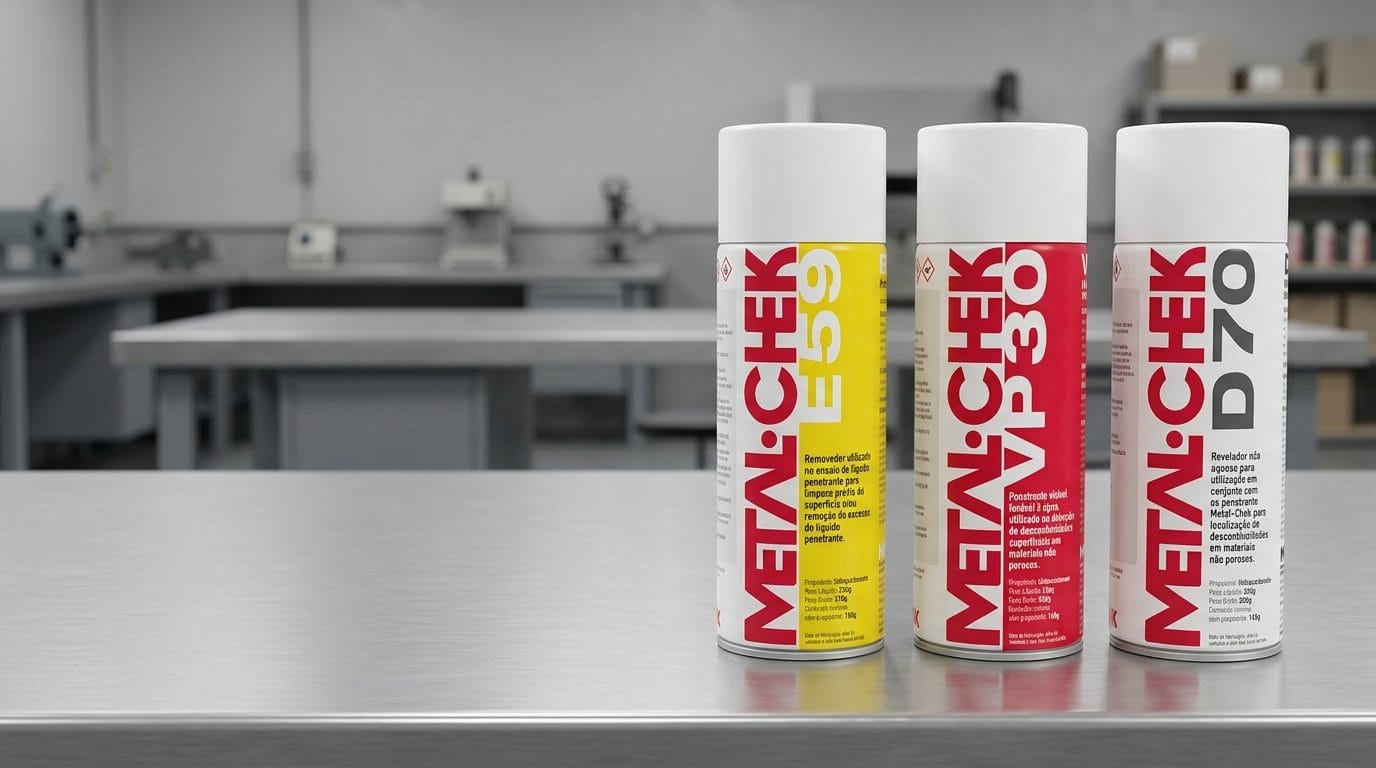
Metal-Chek Line for Liquid Penetrant Testing (LP)

The Metal-Chek line was developed to ensure complete chemical compatibility between all stages of the assay — pre-cleaning, penetration, removal, and development — guaranteeing stable performance, adequate sensitivity, and reproducible results in any industrial application.

Technical Compliance

Metal-Chek products are developed in accordance with applicable national and international standards and must be used in a compatible system by properly trained and qualified personnel .
The combined use of Metal-Chek products ensures uniformity of performance, traceability, and technical compliance , eliminating the risk of incompatibility between stages and guaranteeing accurate and reliable results .


Chemical compatibility is the key factor in ensuring the reliability of liquid penetrant testing.

Mixing products from different manufacturers compromises the chemical balance of the process and can lead to incorrect results, rework, and even inspection failures.

To ensure sensitivity, traceability, and performance in accordance with international standards, it is essential to use all products from the same system and manufacturer , strictly following the manufacturer’s guidelines and applicable procedures .

Compatibility equals reliability — use the complete Metal-Chek system and ensure accurate results.


Continue Learning with Metal-Chek

Explore other technical articles on our blog .Discover our complete line of LP and PM products, developed according to ASTM, ISO, ASME, NM and PETROBRAS standards.Talk to our technical consultants and find the ideal solution for your inspection process.Follow our Instagram page: @metalchek

Revealing: Types and Differences

In Liquid Penetrant Testing (LP), the developer plays an essential role: it is what makes the indications of discontinuities visible. Its function is to form a thin, uniform layer on the clean, dry surface, acting by reverse capillary action —promoting the return of the penetrant retained in the discontinuities to the surface, where the visible indication is formed for evaluation under white/visible light (for visible penetrants) or ultraviolet UV-A light (for fluorescent penetrants), allowing for a clear and reliable assessment.

More than just a product, the developer is a crucial factor in the sensitivity and reliability of the test. Therefore, understanding its variations and applications is fundamental for efficient inspection that complies with technical standards.

Types of Developer and Their Differences

Developers are classified according to their form , and the correct choice depends on the type of penetrant and the inspection environment.

The main categories are listed below:

1. Dry Developer

Dry developer consists of fine powder and forms a light, absorbent film. It is applied to the dry surface after the penetrant has been removed.

  • Application: by immersion, dust chamber, electrostatic spray or spraying.
  • Advantages: high sensitivity and solvent-free; ideal for fluorescent penetrants.
  • Metal-Chek product: D72 Powder Developer , ready to use, non-flammable and easy to remove.

2. Aqueous Developer

Developer prepared in aqueous solution, which forms a uniform white film after drying.

  • Application: by immersion or spraying.
  • Advantages: homogeneous coverage, easy dispersion, and concentration control.
  • Metal-Chek product: D76 Water-Soluble Developer , diluted from 15 to 60 g/L of water, indicated for use with fluorescent penetrants.

3. Non-Aqueous Developer

It consists of fine white particles suspended in solvent, forming an opaque, high-contrast white background . It is the most common type in the field, especially in visible penetrant inspections.

  • Application: Apply in a thin, uniform layer by spraying (aerosol or compressed air gun).
  • Advantages: quick drying, excellent contrast, and easy removal.
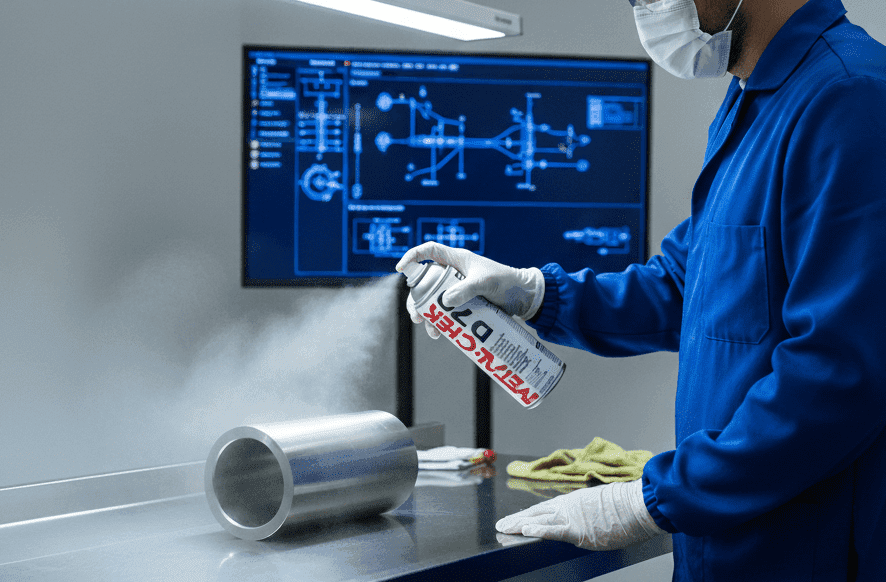
  • Metal-Chek product: D70 Non-Aqueous Developer , available in bulk (5L) and D70 (HI) hydrocarbon propellant aerosol versions, both suitable for fluorescent and visible penetrants.
  • Operating temperature: 10 to 52 °C.

Good Application Practices (for all types)

  • Apply the developer in a thin, even layer , avoiding excess that could mask indications.
  • Allow to dry  before inspection.
  • Use products within their expiration date and store them according to temperature and ventilation recommendations.
  • Inspect under adequate lighting — white light ≥ 1076 lux for visible penetrants or UV-A ≥ 1000 µW/cm² and ambient light ≤ 21 lux for fluorescent penetrants.

Technical Notice

This content is for educational purposes only.The selection of the developer type, application parameters, and operational precautions must follow a qualified procedure approved by a Level 3 Inspector .


Choosing the right developer directly impacts the sensitivity and reliability of penetrant testing.
Each type— dry , aqueous , or non-aqueous —has specific characteristics that must be selected according to the type of penetrant, the inspection conditions, and the required level of sensitivity. The correct choice enhances the quality of the END and ensures more accurate technical decisions.


Revealing the invisible requires precision — choose Metal-Chek products.
The solution for non-destructive testing.

Continue deepening your knowledge: explore other technical articles on the Metal-Chek blog.

Discover our complete line of LP and PM products.

Speak with our technical consultants and discover the best solution for your inspection process.

Follow Metal-Chek on Instagram: @metalchek

Fluorescence in Non-Destructive Testing: Technology that Amplifies Results

In industrial inspection, fluorescence in non-destructive testing (END) is a technology that significantly enhances sensitivity and visual accuracy.

Applied in methods such as Liquid Penetrant (LP) , Magnetic Particle (MP) , and Leak Detection (DV) , this technique allows for the identification of minute discontinuities and micro-leaks invisible to the naked eye. The result is greater safety, reliability, and operational performance.


What is fluorescence?

Fluorescence is an optical phenomenon in which certain substances absorb energy from ultraviolet (UV-A) light and re-emit it in the form of visible light .
In non-destructive testing (END), this physical principle is used to enhance the contrast of indications on metallic and non-metallic parts, facilitating the identification of surface or subsurface defects .

When UV-A light (365 nm) strikes the inspected material, the fluorescent particles or dyes react by emitting intense light—typically in shades of green, yellow, or orange. This makes discontinuities clearly visible , even in hard-to-reach areas.
The result is a highly sensitive , precise, and visually clear test that allows for quick and reliable decisions .


Applications of fluorescence in END methods

1. Liquid Penetrant Testing (LP)

The LP fluorescent (Type I) method is indicated for detecting surface-open discontinuities , such as cracks, pores, lack of fusion, and other defects that may compromise the integrity of a component.

After cleaning and applying the penetrant, the excess is removed and the developer is applied. Under UV-A light , the remaining liquid in the discontinuities emits intense fluorescence, clearly revealing the indications.

Among the main advantages is its versatility of application .
The method can be used on metallic and non-metallic materials , whether magnetic or non-magnetic , such as aluminum, magnesium, austenitic stainless steels, and titanium .
It can also be applied to ceramics, glass, and some types of plastics , provided they are non-porous materials .

Metal-Chek Products:

  • FP-91 and FP-91 HI – Water-washable penetrants, Type I – Method A, Level 2, ideal for inspections requiring greater sensitivity.

Compatible with D70, D72 and D702 developers .


2. Magnetic Particle Testing (MPT)

In ferromagnetic materials, fluorescence enhances the detection of surface and subsurface discontinuities . Fluorescent magnetic particles
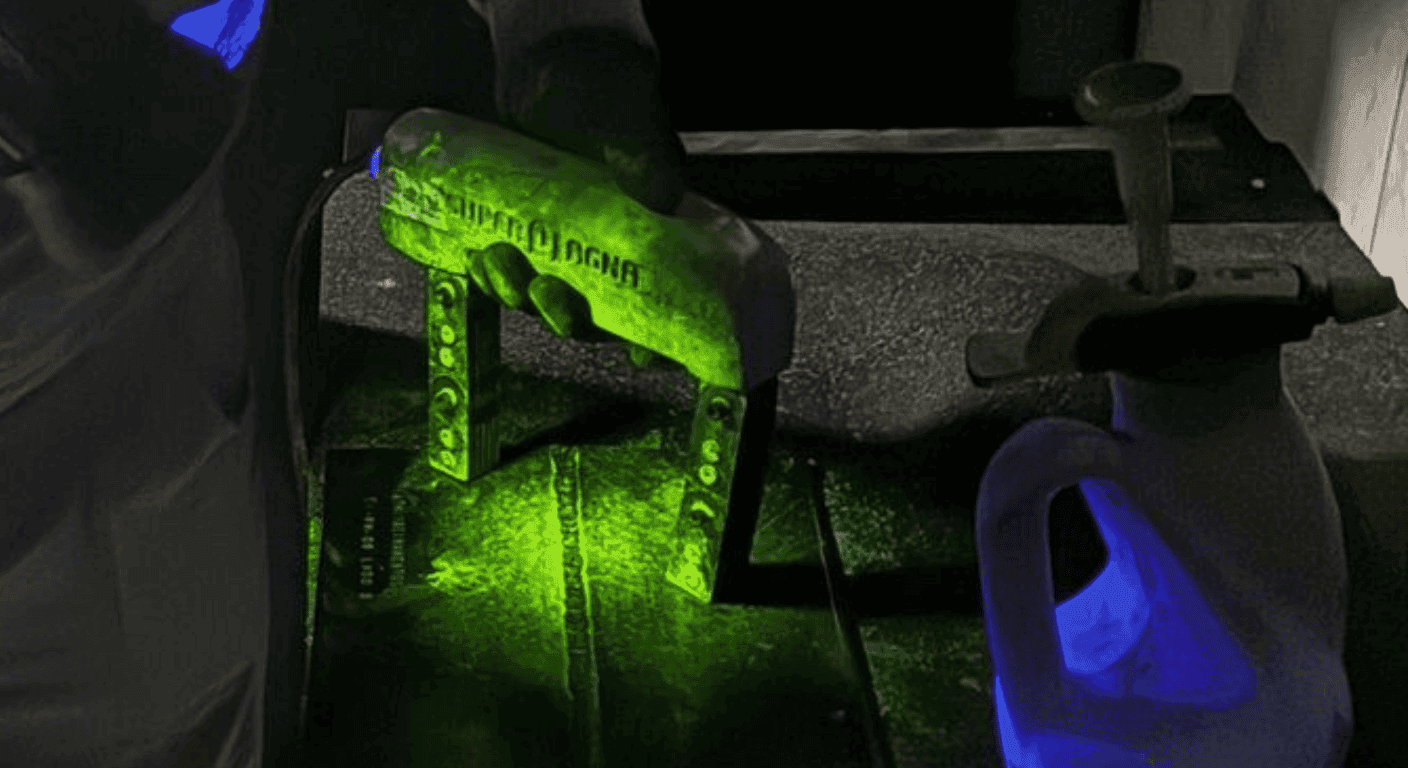
accumulate in regions where the magnetic field escapes, forming visible indications under UV-A light . For magnetic particle testing to be effective, it is essential that the part be magnetized . The application of a magnetic field —circular, longitudinal, or combined—creates magnetic flux lines in the material.

Metal -Chek offers the Supermagna Yoke HMM6 , an alternating current (AC) electromagnetic yoke developed for visible and fluorescent testing. The equipment provides a stable magnetic field and high mobility , making it widely used in industrial, petrochemical, and predictive maintenance inspections.

Metal-Chek Products:

  • Supermagna LY 800 – High-sensitivity fluorescent dry-process magnetic particle.
  • Supermagna LY 2000, LY 2000 V, LY 3000 and LY 3000 V – Wet-applied fluorescent magnetic powder particles, applicable with OMC 10 MMS (oil) or BC 502 SN + water vehicles .
  • Supermagna CLY 2000 VO MMS BP / CLY 3000 O MMS BP / VO MMS BP – Ready-to-use wet (oil) baths with high mobility and contrast.
  • Supermagna DLY 2000 – Water-dispersible wet magnetic particle.
  • Supermagna CRL 265 AG/SN – Dual concentrate (fluorescent/visible), applicable under visible (white) or UV-A light in environments up to 1000 lx.

3. Leak Detection (Leak Testing)

In leak tests, fluorescent additives allow visualization of micro-leaks in hydraulic, pneumatic, and lubrication systems.
Under UV-A light, even the smallest leaks become visible, enabling immediate repairs and preventing critical failures .

Metal-Chek Products:

  • Oil-Glo Ultra SPI Series
    • SPI-OGG (Green) , SPI-OGB (Blue) and SPI-OGW (White) — Fluorescent detectors for oily fluids.
    • Non-flammable, they do not alter the properties of fluids and are NSF certified .
  • Water-Glo Ultra SPI Series – Green (WGG) and blue (WGB) fluorescent dyes for aqueous systems.

UV-A Lighting Equipment

For fluorescent testing, it is essential to use UV-A (365 nm) light sources with a minimum intensity of 1000 µW/cm² on the surface being examined, in accordance with END technical standards.
This intensity ensures adequate contrast and accurate reading of the indications.


Benefits of fluorescence in END

The correct application of fluorescence brings significant technical advantages:

  • High visual sensitivity , revealing minute discontinuities.
  • Greater contrast and clarity of the indications.
  • Safe and versatile application in different methods and materials.
  • Technical compliance with national and international standards.
  • Reduction of rework and operational errors.

Furthermore, fluorescence improves the reliability of results and strengthens quality control in critical inspections.


Fluorescence in non-destructive testing is an essential technology that raises the standard of precision, safety, and reliability in industrial inspections.
By applying this technique in liquid penetrant testing (LP), mechanical testing (PM), and visual diffusion (DV) , enhanced visualization, high sensitivity, and immediate results are obtained , reducing failures and ensuring operational reliability.

With the complete Metal-Chek product line — which includes penetrants and fluorescent particles, leak detection additives, magnetization equipment, and UV-A illumination — your industrial inspection reaches new levels of quality and technical compliance .


See beyond the visible — Metal-Chek fluorescent technology.
Solutions for Non-Destructive Testing.

Talk to our experts
and follow us on @metalchek

Translate