Archives August 2025

E-59: Aliphatic Solvent for Non-Destructive Testing and Heavy Industrial Cleaning

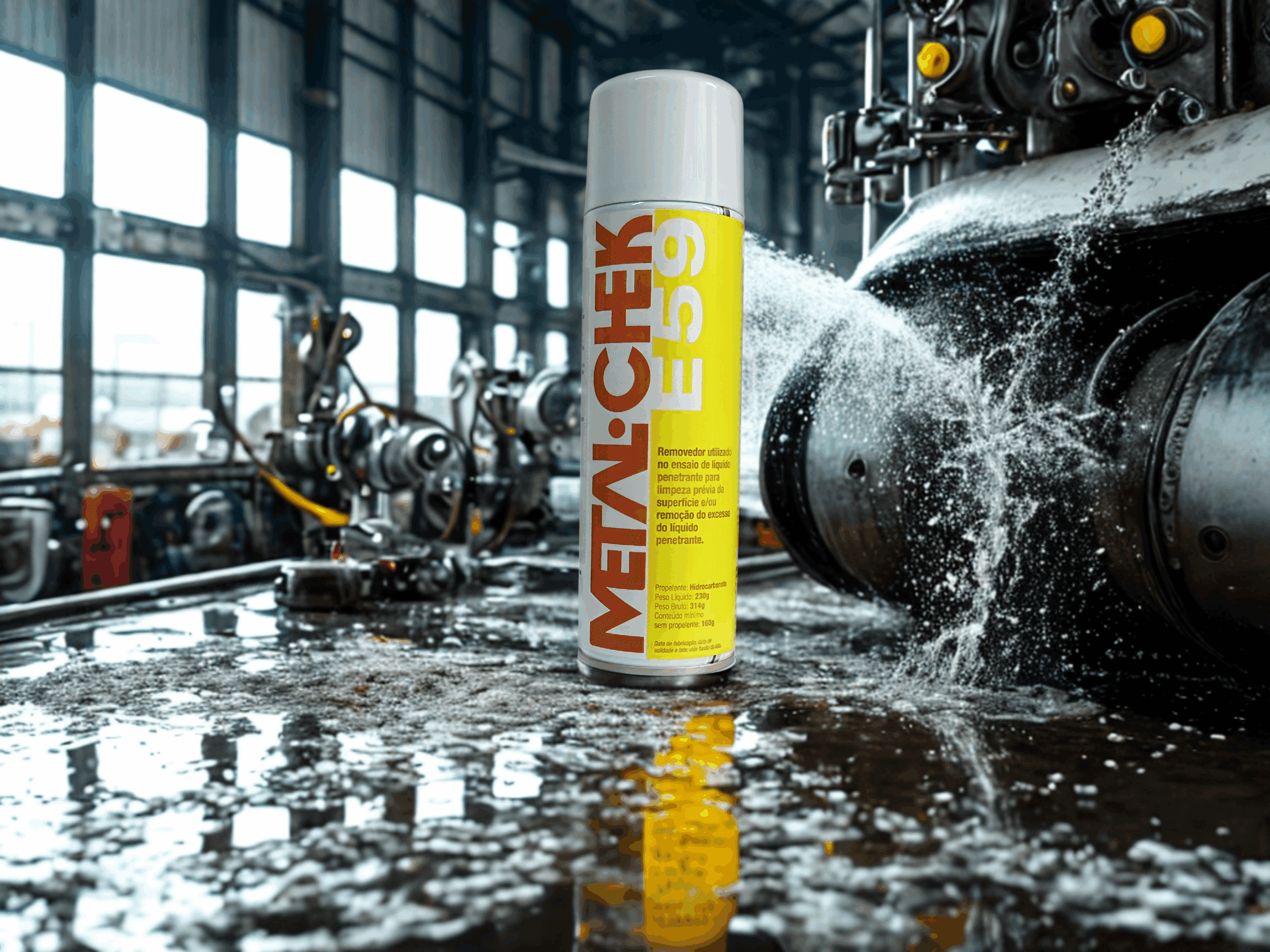
In industrial maintenance, the efficiency of a solvent goes far beyond cleaning. E-59 is a clear example: developed as an aliphatic solvent, it plays a strategic role in both non-destructive testing (END) and heavy-duty cleaning of industrial components, especially in environments where lubricating oil is a constant challenge.


E-59 in Non-Destructive Testing

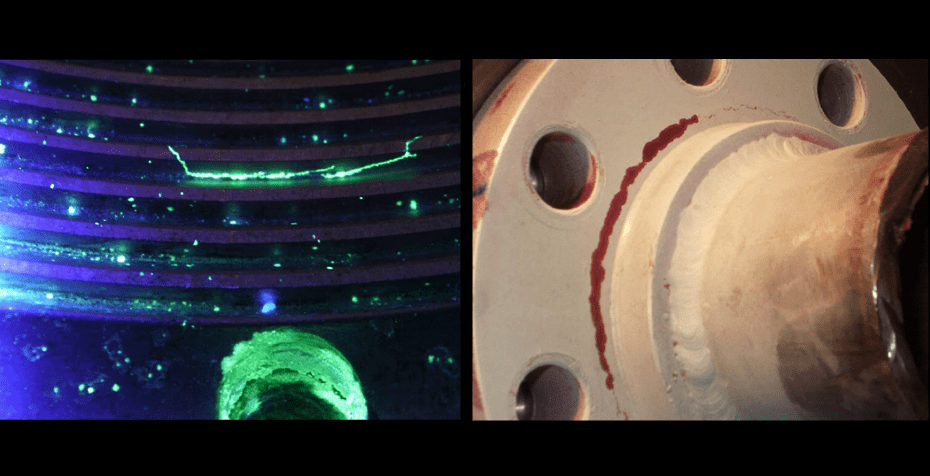
In inspection and quality control processes, choosing the correct solvent directly impacts the effectiveness of the tests. E-59 is widely used as part of the surface preparation steps in liquid penetrant testing , ensuring that parts and components are properly cleaned and free of contaminants before the method is applied. This results in greater accuracy in detecting discontinuities.


Applications in Oil Cleaning and Lubrication

Beyond its use in inspection applications, the E-59 is recognized for its high efficiency in removing lubricating oil from engine blocks, mechanical parts, and impregnated surfaces. This versatility makes the product an ally in sectors that deal with high levels of oil contamination, such as engine rebuilding shops, heavy maintenance, and railway industries.


Use in Grinding Shops and the Railway Sector

Engine rebuilding companies use E-59 for the precise cleaning of engines and components, ensuring that the reassembly process occurs under ideal conditions. In the railway sector, especially in locomotive manufacturing companies , the product stands out for its ability to remove oil residue from large and complex parts, where cleanliness is critical for the reliability and durability of the equipment.


Advantages of the E-59

  • High performance aliphatic solvent.
  • Ideal for surface preparation in non-destructive testing.
  • Excellent removal of lubricating oil and grease.
  • Widely used in engine rebuilding shops and locomotive companies.
  • Versatility: suitable for industrial maintenance, inspection, and heavy-duty cleaning.

E-59 is not just a solvent. It represents a practical and reliable solution for sectors that demand deep cleaning and precision in non-destructive testing. Whether in engines, industrial parts, or large railway systems, its application guarantees efficiency, safety, and reliability in day-to-day maintenance.

Want to learn more about the E-59 and its applications? Talk to our team !

Read also: High-Quality Industrial Inspections Begin with a Clean Surface

Follow us on Instagram: @metalchek

How to Specify Non-Destructive Testing (END) in Purchase Proposals (RFQ)

A practical guide for purchasers and supply engineers.

In industry, Non-Destructive Testing (END) is fundamental to ensuring the quality, safety, and conformity of parts and equipment. However, many Requests for Quotations (RFQs) fail because they do not correctly specify what is being requested—whether it is the  contracting of END services  or the  acquisition of supplies and equipment  to perform it.

Below, we present a practical guide to preparing clear and complete RFQs, with real-world examples from  Metal-Chek  and  Supermagna products .


1. Define what you are buying: a service or a supply.

First of all, determine if your RFQ will be for:

  • END service  – the supplier performs the test and delivers the technical report.
  • Materials/supplies/equipment for END  – your team or service provider will use the purchased products to perform the test.

This distinction avoids confusion and ensures that the specifications are suitable for what you want to buy.


2. Specifying the contracting of the END service

When hiring a service, describe  how the test should be conducted  and  what acceptance criteria  will be adopted.

a) Method and technique

Specify the method and technique:

  • Example: Liquid penetrant testing, Type I, Method A, Level 2, using  Metal-Chek FP 91
  • Example: Dry magnetic particle extraction, white powder, using  Supermagna WD 55

b) Reference standard

Define the applicable standard (ASTM E165, ASTM E709, ASME Section V, AWS D1.1 or internal standards such as Petrobras N-1596/N-1598).

c) Acceptance criteria

Determine codes and levels (e.g., ASME VIII Div.1, EN 1369, Level 2 or 3).

d) Inspector qualifications

Require  SNQC/ABENDI  or  ASNT SNT-TC-1A certification , Level II or III, depending on the method.

e) Implementation conditions

Include requirements such as cleanliness, adequate lighting (lux or µW/cm²), temperature, humidity, and application times.

f) Documentation and traceability

Request reports with photos, sketches, and part identification, ensuring traceability by batch or serial number.


3. Specifying the purchase of materials and equipment for END

When purchasing supplies or equipment, the RFQ (Request for Quotation) should contain  technical details of the product .

a) Penetrant Liquids

  • FluorescentMetal-Chek FP 91 , Type I, Method A, Level 2
  • VisibleMetal-Chek VP 30 , Type II, Method A
  • VisibleMetal-Chek VP 31 , Type II, Method C

b) Developers

  • Dry:  Metal-Chek D72 , form a
  • Non-aqueous:  Metal-Chek D70 , form d, e
  • Aqueous:  Metal-Chek D76 , form b

c) Removers / Cleaners

  • Solvent: Metal-Chek E 59 , Class 2
  • Solvent: Metal-Chek R 501 , Class 1

d) Magnetic Particles

  • White dry track: Supermagna WD 55
  • Yellow dry track: Supermagna YD 404
  • Fluorescent wet process: Supermagna LY 2000
  • Visible red wet path: Supermagna RW 222
  • Visible black wet sample: Supermagna BW 333

e) Equipment


4. Best practices for any END RFQ

  • Be specific: avoid generic terms like “LP test” without specifying the method, type, and standard.
  • Standardize the descriptions across all requests.
  • Approve the technical proposal before the price.
  • Include safety and environmental requirements (PPE, proper disposal of products).

Conclusion

A clear specification — whether for contracting END services or acquiring Metal-Chek and Supermagna supplies — ensures that the process is executed with quality, reduces risks, and avoids rework.

Want to learn more?   Read also: How to choose the ideal penetrant type for each application .

Speak to our technical team .

Follow us on Instagram: @metalchek

How to Choose the Ideal Penetrant Type for Each Application – Non-Destructive Testing

In penetrant testing, choosing the correct product is crucial for the  sensitivityreliability, and compatibility of the test. Specifying an inappropriate penetrant can lead to incomplete detection of discontinuities, material damage, or even unnecessary rejections.

This guide will help you understand which factors to consider  and how to select the most suitable penetrant for your application, with real-world examples from the Metal-Chek line.


1. Begin by understanding the classification of penetrants.

Penetrant liquids are classified primarily by  typeremoval method, and sensitivity level.

a) Type

  • Type I – Fluorescent.
    High sensitivity, inspection under UV light. Ideal for detecting very fine discontinuities.
    Ex.:  Metal-Chek FP 91 , Type I, Method A, Level 2.
  • Type II – Visible.
    Indications visible to the naked eye under white light. Simpler and faster, ideal for field inspections.
    Ex.:  Metal-Chek VP 30 , Type II, Method A;  Metal-Chek VP 31 , Type II, Method C.

b) Removal method

  • A – Washable with water  (easy removal with water)
  • B – Lipophilic post-emulsifiable  (emulsifier applied after the penetrant)
  • C – Solvent removable  (removal with cloth and solvent, such as  Metal-Chek E 59  or  Metal-Chek R 501 )
  • D – Hydrophilic post-emulsifiable  (water-based emulsifier)

c) Sensitivity level (Type I)

It ranges from  Level 1  (low sensitivity) to  Level 4  (ultra-high). The more critical the component, the higher the recommended level.


2. Consider the material to be inspected.

  • Stainless steels, titanium, and special alloys : require penetrants with low halogen and sulfur content, and compatible developers.
    Ex.:  Metal-Chek FP 91  with contaminant certification according to ASTM E165.
  • Carbon steel and ferrous materials : greater flexibility of choice, depending on the acceptance criteria.
  • Porous materials : require care to avoid excessive penetration and false readings.

3. Inspection environment and conditions

  • Environments with low, controlled lighting : fluorescent (Type I) is preferable.
  • Field inspection or areas with restricted UV lighting : opt for visible (Type II).
  • Locations without running water : consider method C (removable solvent) for cleaning up excess water.

4. Compliance with standards and criteria

Always align the penetrant and developer with the required standard:

  • ASTM E165, ISO 3452, ASME Section V, Petrobras N-1596.
    And include in the RFQ the requirement for a batch certificate and SDS (Safety Data Sheet).

5. Combining penetrant, developer, and remover

For an effective test, choose a compatible set:

  • Metal-Chek FP 91  (fluorescent) +  Metal-Chek D70  (non-aqueous developer) +  Metal-Chek E 59  (solvent remover).
  • Metal-Chek VP 30  (visible) +  Metal-Chek D72  (dry developer) +  Metal-Chek R 501  (solvent remover).

Conclusion

Choosing the right penetrant is not just a matter of preference — it’s  a guarantee of reliable results and compliance with technical standards .
Metal-Chek offers solutions for different sensitivity levels, methods, and types, always accompanied by technical certification and specialized support.

Contact the Metal-Chek technical team.

Follow us on Instagram:  @metalchek

Read also:

The Main Methods of Industrial Inspection and How to Choose the Ideal One

How to Choose the Ideal Penetrant Testing Process for Your Application?

Do you know what makes a penetrating liquid effective?

Translate