How to Choose the Ideal Penetrant Type for Each Application – Non-Destructive Testing
In penetrant testing, choosing the correct product is crucial for the sensitivity, reliability, and compatibility of the test. Specifying an inappropriate penetrant can lead to incomplete detection of discontinuities, material damage, or even unnecessary rejections.
This guide will help you understand which factors to consider and how to select the most suitable penetrant for your application, with real-world examples from the Metal-Chek line.
1. Begin by understanding the classification of penetrants.
Penetrant liquids are classified primarily by type, removal method, and sensitivity level.
a) Type
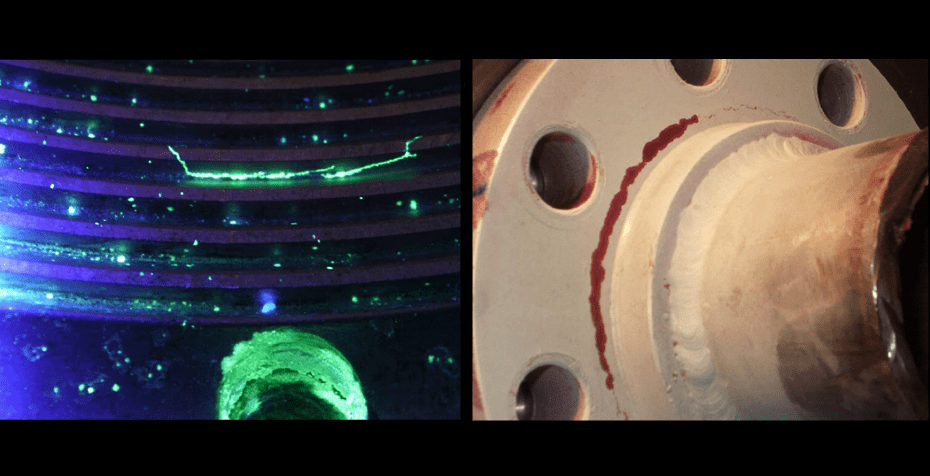
- Type I – Fluorescent.
High sensitivity, inspection under UV light. Ideal for detecting very fine discontinuities.
Ex.: Metal-Chek FP 91 , Type I, Method A, Level 2. - Type II – Visible.
Indications visible to the naked eye under white light. Simpler and faster, ideal for field inspections.
Ex.: Metal-Chek VP 30 , Type II, Method A; Metal-Chek VP 31 , Type II, Method C.
b) Removal method
- A – Washable with water (easy removal with water)
- B – Lipophilic post-emulsifiable (emulsifier applied after the penetrant)
- C – Solvent removable (removal with cloth and solvent, such as Metal-Chek E 59 or Metal-Chek R 501 )
- D – Hydrophilic post-emulsifiable (water-based emulsifier)
c) Sensitivity level (Type I)
It ranges from Level 1 (low sensitivity) to Level 4 (ultra-high). The more critical the component, the higher the recommended level.
2. Consider the material to be inspected.
- Stainless steels, titanium, and special alloys : require penetrants with low halogen and sulfur content, and compatible developers.
Ex.: Metal-Chek FP 91 with contaminant certification according to ASTM E165. - Carbon steel and ferrous materials : greater flexibility of choice, depending on the acceptance criteria.
- Porous materials : require care to avoid excessive penetration and false readings.
3. Inspection environment and conditions
- Environments with low, controlled lighting : fluorescent (Type I) is preferable.
- Field inspection or areas with restricted UV lighting : opt for visible (Type II).
- Locations without running water : consider method C (removable solvent) for cleaning up excess water.
4. Compliance with standards and criteria
Always align the penetrant and developer with the required standard:
- ASTM E165, ISO 3452, ASME Section V, Petrobras N-1596.
And include in the RFQ the requirement for a batch certificate and SDS (Safety Data Sheet).
5. Combining penetrant, developer, and remover
For an effective test, choose a compatible set:
- Metal-Chek FP 91 (fluorescent) + Metal-Chek D70 (non-aqueous developer) + Metal-Chek E 59 (solvent remover).
- Metal-Chek VP 30 (visible) + Metal-Chek D72 (dry developer) + Metal-Chek R 501 (solvent remover).
Conclusion
Choosing the right penetrant is not just a matter of preference — it’s a guarantee of reliable results and compliance with technical standards.
Metal-Chek offers solutions for different sensitivity levels, methods, and types, always accompanied by technical certification and specialized support.
Contact the Metal-Chek technical team.
Follow us on Instagram: @metalchek
Read also:
The Main Methods of Industrial Inspection and How to Choose the Ideal One
How to Choose the Ideal Penetrant Testing Process for Your Application?
