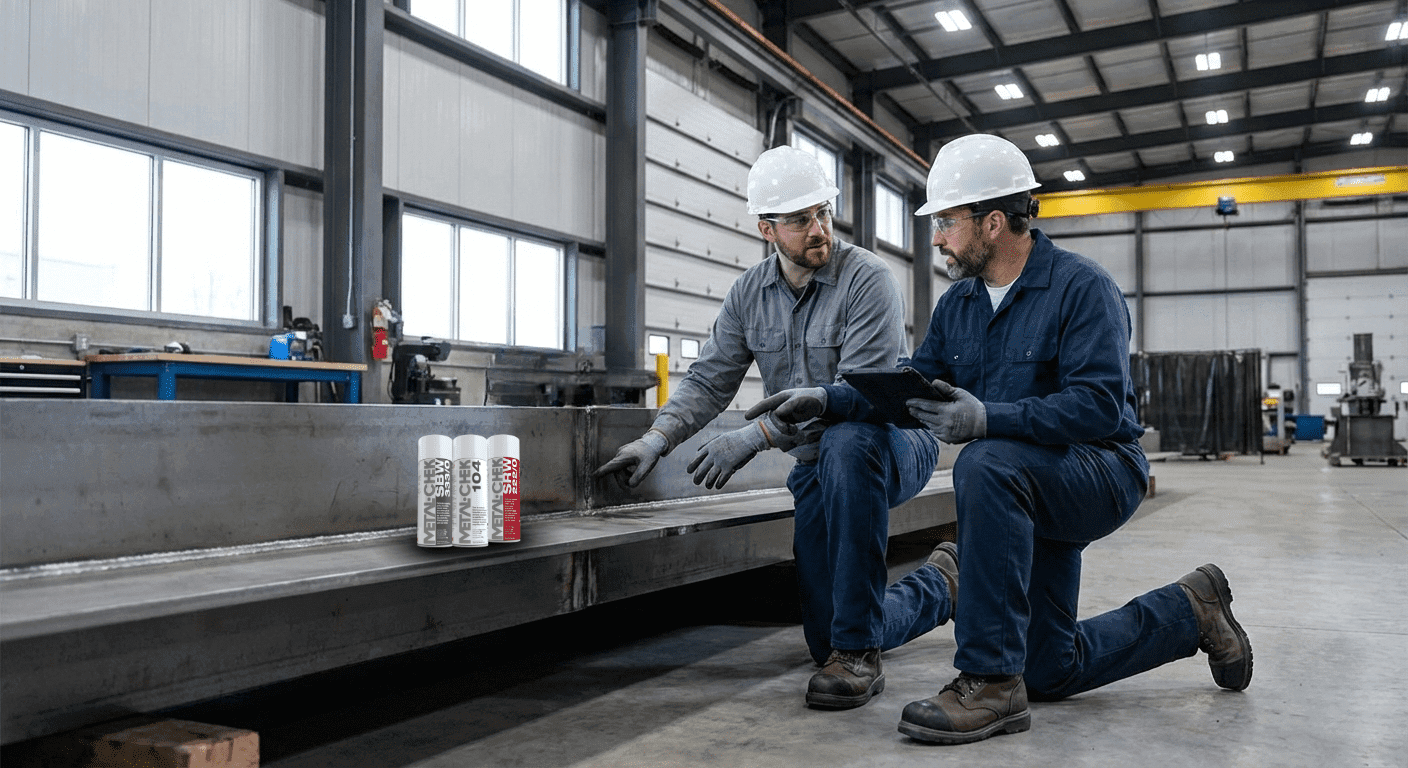
Operation and END: a strategic partnership in Quality Control
In an industrial setting, Quality Control is responsible for ensuring that products and processes meet established technical, regulatory, and contractual requirements.
Non-Destructive Testing (END) is an integral part of this Quality Control system. It consists of technical tools used to verify the integrity of materials and components without compromising their future use.
However, in many industrial environments, there is a disconnect between operations and the Quality or END departments.
On one side, those who execute.
On the other, those who inspect.
When this relationship is misunderstood, the perception arises that inspection exists only to point out flaws or interrupt the process. This view generates internal noise and weakens the quality culture.
Operation and END are not competitors. They operate at different stages of the same objective: ensuring the technical conformity and reliability of the final product .
The role of the operation in process integrity
Execution is the foundation of any industrial result.
It is the operational team that applies procedures, controls parameters, performs welding, assembly, and adjustments that determine the component’s performance.
Quality begins in the production process. When execution is consistent and aligned with technical requirements, inspection tends to confirm this conformity.
The operation, therefore, is not merely an executor; it is an active part of the quality control system.
The role of END in technical verification
Non-destructive testing serves to verify whether a product meets integrity criteria.
END does not create discontinuities.
It evaluates what is already present in the material or what is inherent to the manufacturing process.
When a relevant indication is identified, the objective is technical: to prevent an unsuitable condition from progressing in the process or reaching the customer.
Internal inspection reduces major risks, avoids external impacts, and preserves the integrity of the production system.
When conflict arises
Disagreements between operation and quality often arise when inspection is perceived as an obstacle to the pace of production.
However, a nonconformity identified internally represents an opportunity for controlled correction. Conversely, a failure detected externally can compromise contracts, schedules, reputation, and operational safety.
END acts as a validation step within the production flow, not as a barrier, but as a mechanism for technical verification.
When operations and END work as partners
Mature industrial environments exhibit clear characteristics:
- The operational team understands the acceptance criteria applicable to the process;
- The inspector understands the variables and limitations of the production process;
- There is objective technical communication;
- Adjustments are treated as process improvements, not as personal conflicts.
When integration exists:
✔ Rework decreases
✔ Process predictability increases
✔ Approval rate improves
✔ Trust between departments is strengthened
Inspection is now recognized as part of the quality workflow, and not as an impediment.
Quality culture: shared responsibility
Quality is not exclusive to the END sector.
It involves planning, execution, verification, and continuous improvement. When everyone understands their role within the system, the environment becomes more collaborative and technically consistent.
A strong quality culture reduces costs and improves performance indicators in a sustainable way.
Procedures and products as elements of stability
The partnership between operations and END also depends on a solid technical foundation:
- clear and well-defined procedures;
- objective acceptance criteria;
- Standardization of inspection methods;
- Reliable and consistent inspection products.
When parameters are clearly defined and the products used deliver consistent, specification-compliant performance, the process becomes more stable and technically reliable. Consistency in results strengthens trust between departments.
Operation and Non-Destructive Testing operate at different stages of the process, but share the same purpose: to ensure that the delivered product conforms to integrity requirements.
Overcoming the idea that the quality sector is merely a “pointer of errors” is essential to consolidating more mature, cooperative, and efficient industrial environments.
When execution and verification work in an integrated way, the result is a more stable, safe, and reliable production system.
Excellence in products for those seeking reliable results.
Metal-Chek provides complete solutions for Non-Destructive Testing, with products developed according to the main ASTM, ISO, ASME, NM and PETROBRAS standards, contributing to consistent and technically reliable inspections.
– Read more technical content about END on our blog
– Follow Metal-Chek on Instagram: @metalchek and on LinkedIn
