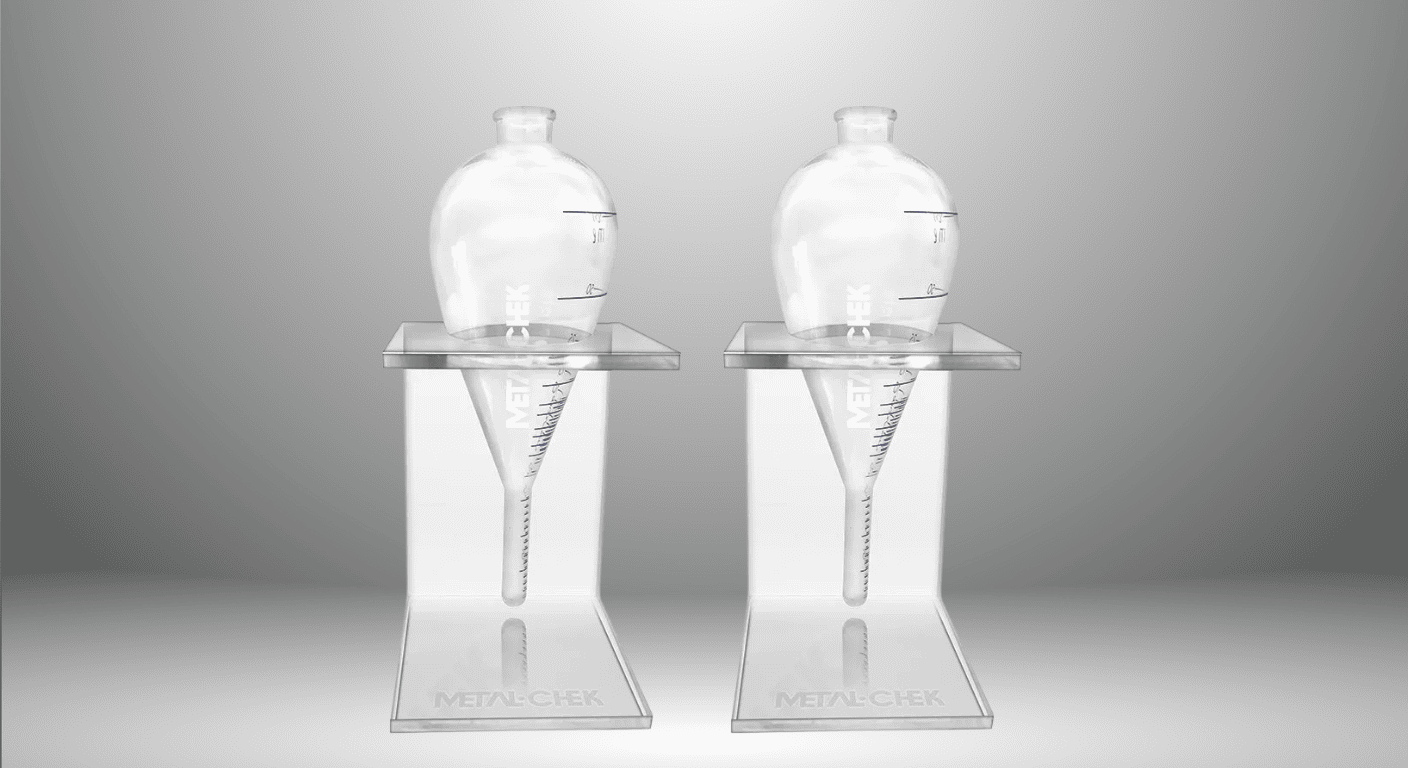
Pear-shaped Decanter Tube: Concentration Control
Understand how the pear-shaped decanting tube contributes to the precision and reproducibility in controlling the concentration of magnetic particles (MP), in accordance with applicable technical standards.
The role of the per a type decanting tube
Magnetic particle testing (MPT) is widely used to detect surface and subsurface discontinuities in ferromagnetic materials. In wet
testing, the appropriate concentration of magnetic particles in the bath is crucial for the sensitivity and repeatability of the results.
One technical detail makes all the difference: the use of the “pear” type decanting tube, an essential accessory for measuring the bath concentration with precision, speed, and traceability.
Supermagna Pear-Type Decanter Tube: what it is and how it works
The Supermagna Pear-shaped Decanter Tube is an auxiliary accessory used to determine the quantity of magnetic particles per volume of fluid in the suspension used in wet dispersion testing. With a graduated scale, it allows for the reading of the volume of particles settled after a period of rest.
There are two main models, developed according to the type of particle:
- Supermagna Decanting Tube with a 0.1 ml scale (fine scale): suitable for colored particles ;
- Supermagna Decanting Tube with a full scale of 0.05 ml (most sensitive scale):suitable forfluorescent particles.
Main applications:
- Verification of the correct concentration of the magnetic particle bath before performing the test;
- Assessment of contamination levels in the bath during use.
Why concentration control is essential
With continuous use, the magnetic particle bath can undergo changes that directly compromise the reliability of the results. Among the main causes are:
- Evaporation of the liquid phase;
- Natural settling of particles;
- Contamination by oil, dirt, or metallic residue.
These variations can affect the sensitivity of the assay:
- Excess particles : generate false readings and increase background noise;
- Low concentration : reduces visibility and makes it difficult to detect actual discontinuities.
In addition to proper control, the quality of the magnetic particles used is a determining factor in the test’s performance.
Metal-Chek magnetic particles are developed with specific formulations to meet regulatory requirements.
How to properly use the Supermagna Pear-shaped Decanter Tube
The use of the Supermagna pear-shaped decanter tube
must follow the specific instructions for each product and vehicle, in addition to the guidelines of the qualified test procedure. Generally, the process involves agitating the suspension for homogenization, filling the tube to the indicated volume, and allowing it to stand for a sufficient time for the particles to settle by gravity.
After the defined period, the decanted volume is read, observing the interface between the fluid and the particles.
The reading must be performed according to the type of particle used:
– For colored particles, visible light should be used to provide good visibility of the separation line between the fluid and the particles.
– For fluorescent particles, the reading requires the use of ultraviolet (UV-A) light, in a darkened environment, according to the requirements established by applicable standards.
The results obtained serve as a comparison with the reference values indicated by the manufacturer of the magnetic particles or according to the technical procedure approved by a Level 3 Inspector, ensuring that the concentration control is in accordance with the established practices for the test.
Normative references
Concentration control with the Supermagna pear-shaped decanter tube is supported by the main international and national standards applicable to magnetic particle testing, such as:
- ASTM E709 – Standard Guide for Magnetic Particle Testing
- NM 342 – Non-Destructive Testing — Magnetic Particles — Discontinuity Detection
- PETROBRAS N-1598 – Magnetic Particle Testing
- ASME Section V, Article 7 – Magnetic Particle Examination
Good practices and frequency of control
To maintain suspension stability, it is recommended to:
- Perform concentration checks daily (or before each inspection shift);
- Record the results in spreadsheets or quality control forms;
- Renew the bath whenever there is visible contamination, foam, or variation outside the defined limits ;
- Periodically check the physical condition of the settling tube (cracks, dirt, or illegible scale).
These practices contribute to reproducibility in testing and reliability in results, in order to avoid rework and waste.
Technical notice
This content is for educational purposes only. The application of the test methods and parameters must follow a qualified procedure approved by a Level 3 Inspector.
Metal-Chek Excellence
Excellence in products for those seeking reliable results.
Metal-Chek provides complete solutions for Non-Destructive Testing (END) : magnetic particles, contrast dyes, yokes, accessories, and settling tubes — all developed according to the main ASTM , ASME , NM , and PETROBRAS standards.
Talk to our experts
and follow us on @metalchek
