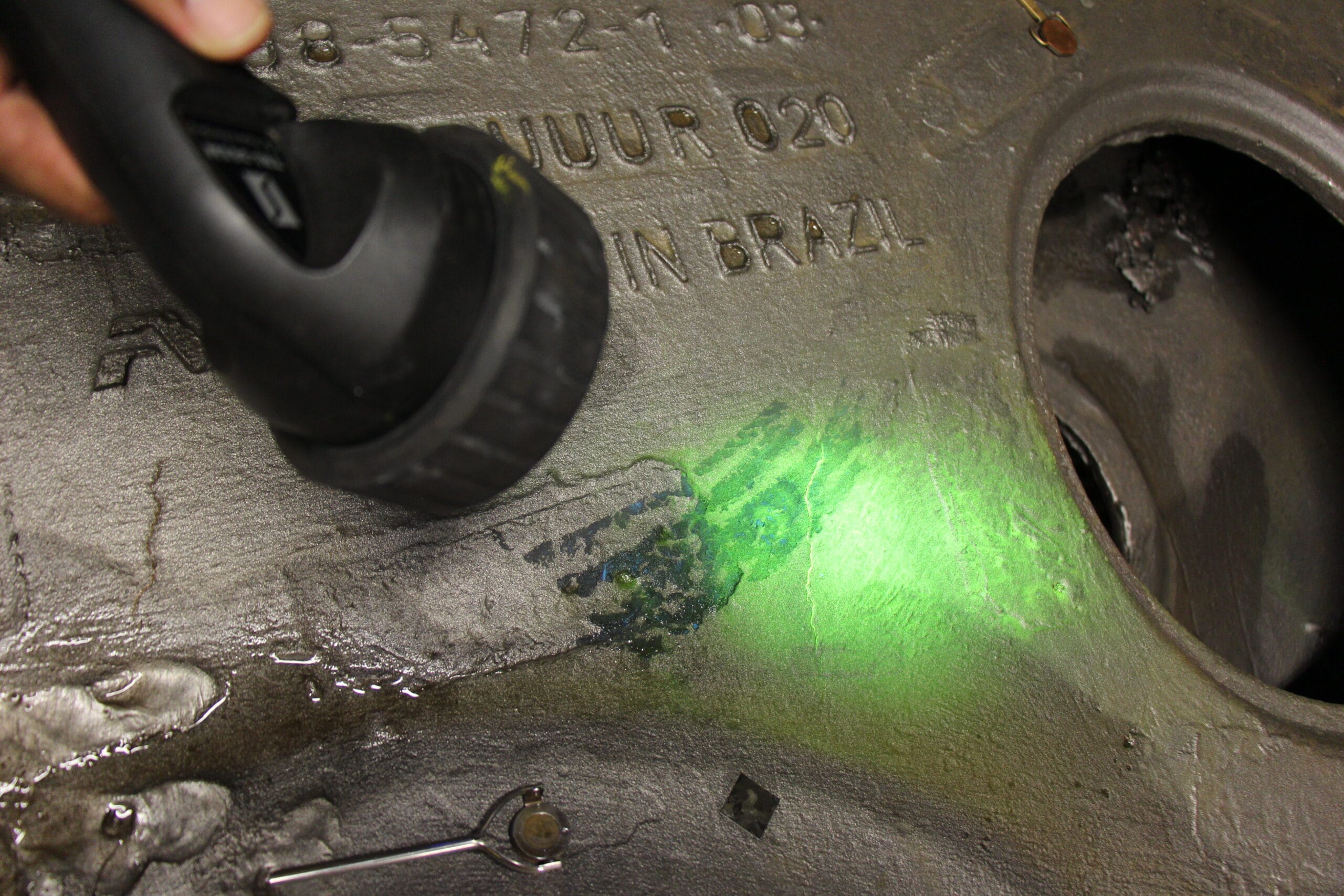
Predictive Maintenance in Industry: Benefits of Non-Destructive Testing
Operational reliability is one of the cornerstones of modern industry. With increasing pressure to reduce costs and enhance asset safety and efficiency, predictive maintenance has become essential. In this context, non-destructive testing (END) plays a decisive role, adding precision and safety to technical and operational decision-making.
The adoption of continuous monitoring technologies and smart sensors has driven the digital revolution in industry, aligning with the principles of Industry 4.0 . Within this ecosystem, ENDs (Non-Destructive Testing) are fundamental for validating data and expanding the ability to anticipate failures.
This article explores how the integration of sensors, monitoring systems, and methods such as liquid penetrant testing , magnetic particle testing, and leak detection contributes to the efficiency of predictive maintenance. We also present how Metal-Chek, a national leader in END products, enhances this integration with technology, quality, and regulatory compliance.
Predictive Maintenance: Far Beyond Traditional Inspection
Predictive maintenance relies on collecting and analyzing data in real time to predict failures and avoid unexpected downtime. It is a strategy focused on the actual condition of the equipment, in contrast to corrective (post-failure) or preventive (fixed interval) maintenance.
Common tools of predictive maintenance:
- Temperature, vibration, and pressure sensors;
- Spectral and eddy current analysis;
- Infrared thermography;
- Ultrasound and tribological analysis (oil monitoring);
- And of course, Non-Destructive Testing , which complements automated alerts with a detailed and visual approach to the failure.
Technical and economic benefits:
- Prevention of unscheduled downtime;
- Increased lifespan of components and assets;
- Cost reduction through reduced rework and parts replacement;
- Improved safety in industrial operations and the trade of high value-added products;
Companies in the industrial and commercial sectors have been increasingly investing in technologies that allow for greater operational predictability, aligning themselves with the global trend of digital transformation in industry.
Non-Destructive Testing: The Basis of High-Precision Inspection
Non-destructive testing (END) techniques are inspection methods that analyze materials, parts, and welds without compromising their structural integrity. They are widely used to detect cracks, inclusions, porosity, delamination, and other defects that cannot be visually identified.
In predictive maintenance, END (Non-Destructive Testing) offers:
- Visual and technical confirmation of anomalies detected by sensors;
- Monitoring the spread of structural defects;
- Photographic record and traceable technical documentation;
- Support for decision-making based on concrete evidence;
- Reducing uncertainty during planned interventions;
- Compliance with national and international standards for quality, safety, and traceability.
Main methods:
- Penetrant Liquid (PL) : excellent for surface cracks in metals and non-metallic materials;
- Magnetic Particles (MP) : used on ferromagnetic materials, detects surface and subsurface cracks;
- Industrial Ultrasound : ideal for locating internal defects with high precision;
- Industrial radiography : provides internal images of complex structures;
- Eddy Current : useful for thin layers and quick inspections;
- Infrared thermography : thermal visualization of abnormal heating points.
These methods are routinely applied in inspections of welding, boilers, pressurized pipelines, valves, aeronautical structures, and parts subject to mechanical wear. The advantage lies in the early detection of cracks, porosity, delamination, and other types of structural defects, even in aggressive or difficult-to-access environments.
Industry 4.0 and the Intelligent Integration between Sensors and END
Industry 4.0 is transforming the way we manufacture, maintain, and manage industrial assets. The connectivity between sensors, software, machines, and people enables a systemic and predictive view of the entire operation.
In this context, ENDs (Non-Destructive Testing) take on a new function: to physically validate the data collected automatically . In other words, the sensors detect abnormal operating patterns, while the tests confirm (or rule out) the presence of real structural flaws.
Practical example:
A sensor detects increased vibration in a critical motor. Subsequently, a penetrant testing is performed on the support base area, revealing a superficial “U”-shaped crack. This visual confirmation allows for localized interventions, reducing downtime.
Benefits of integration:
- Correlation between digital data and physical evidence;
- Decisions based on technical grounds;
- Optimization of maintenance plans;
- Unnecessary replacements are avoided;
- Minimizing downtime;
- Increasing predictability and reducing uncertainty.
The integration between ENDs (Non-Destructive Testing) and sensors is an essential step towards achieving autonomous maintenance and reliability-based management . This approach fits perfectly into the digitalization strategies of Brazilian industry and commerce.
Metal-Chek Solutions: High Performance for Predictive Inspections
Metal-Chek offers a complete line of products for Non-Destructive Testing (END) , developed with high-quality raw materials and rigorous manufacturing control.
The Penetrant Liquids , Removers, and Developers meet the requirements of AMS 2644 and Petrobras N-2370 standards, and also comply with Petrobras N-1596, ASME Section V, ASTM E1417, and ISO 3452-3 standards.
In the Magnetic Particle line, SuperMagna offers consumables with balanced particle size, ensuring maximum sensitivity and precision in detecting discontinuities. The particles are manufactured according to AMS 3040 to 3046 standards and meet the requirements of Petrobras N-1598, ASTM E1444, ASME Section V, and ASTM E709 standards.
This credibility positions the brand as a strategic partner for companies that adopt predictive maintenance with a focus on efficiency and safety.
These products are present in segments such as oil and gas, aerospace, rail, mining, power generation, and industrial manufacturing, consolidating the application of END as an integral part of predictive strategy.
Featured solutions:
Penetrant Liquid
Metal-Chek’s penetrant liquid is ideal for detecting surface discontinuities in metallic and non-metallic materials (such as aluminum, stainless steel, nickel alloys, ceramics, and technical plastics). The product line ranges from visible to fluorescent products, offering high penetration and contrast power.
Process steps:
- Surface cleaning;
- Application of the penetrant (visible or fluorescent);
- Controlled penetration time;
- Excess removal;
- Applying the developer;
- Assessment by a qualified inspector.
Highlights of the Metal-Chek Line:
- VP 30: Visible, water-washable – ideal for rough surfaces.
- VP 31: solvent-removable visible – suitable for critical inspections of metals subject to oxidation.
- FP 91: Water-washable fluorescent – general use with medium sensitivity.
- High Temperature VP 302: inspections of parts operating between 52 °C and 120 °C.
Magnetic Particles
An effective method for detecting surface and subsurface cracks and discontinuities in ferromagnetic materials. The SuperMagna line offers extreme precision and sensitivity. Available in dry and wet versions, fluorescent or visible.
Application:
- Cast, rolled, machined or welded parts ;
- Inspections during or after manufacturing;
- Surfaces exposed to high temperatures (up to 300 °C in some products).
How it works:
- Magnetizing the workpiece with a yoke or stationary equipment;
- Particle application (dry or wet methods);
- Visual identification of the defect by the agglomeration of particles in the magnetic leakage field.
Highlights of the SuperMagna Line:
- SuperMagna LY 3000: latest generation, wet fluorescent, extremely high sensitivity.
- SuperMagna WD 55 / YD 404: dry process, for hot parts (up to 300°C)
- SuperMagna LY 2000: the best-known wet fluorescent printer on the national market.
- SuperMagna CRL 265: dual particle, ideal for environments with alternating visible and UV-A inspection.
Equipment:
YOKE HMM6: high-performance, robust, and certified portable equipment for use in demanding industrial environments.
These products are present in segments such as oil and gas, aerospace, rail, mining, power generation, and industrial manufacturing, consolidating the application of END as an integral part of predictive strategy.
Real-World Applications of Predictive Maintenance with END
1. Aeronautical Industry
- High operational risk requires strict control.
- Lightweight alloy parts, such as titanium and aluminum, are routinely inspected with fluorescent penetrant liquid .
- The part’s history is digitally recorded for complete traceability.
2. Iron and Steel Industry and Metallurgy
- High temperatures and mechanical stress accelerate degradation.
- Magnetic particle inspection reveals cracks in cylinders, rollers, and shafts while they are still in the production line.
- Maintenance can be planned without interrupting the production process.
3. Power Generation (Hydroelectric, Thermal, Wind Power Plants)
- Turbines, ducts, and blades require periodic inspection.
- Sensors detect abnormal vibrations or noises.
- ENDs confirm the failure before there is a risk of collapse.
4. Railways
- Rails and axles are subject to cyclic stress.
- Predictive maintenance allows for scheduling replacements before breakdowns occur.
- Metal -Chek provides portable kits for quick and effective field inspections.
5. Shipbuilding and Offshore Industry
- Harsh environments with salinity, humidity, and temperature variations.
- END (Non-Destructive Testing) is applied to structural welds, valves, hulls, and cable passages.
- The use of particles and liquids specifically designed for marine environments ensures precision even under adverse conditions.
The Strategic Importance of ENDs in Industry and Commerce
Companies in the industrial and commercial sectors that integrate END (Non-Destructive Testing) into their predictive maintenance process reap significant results: reduced downtime, greater quality control, legal security, and market competitiveness.
In addition to technical benefits, non-destructive testing contributes to:
- Meeting regulatory requirements (INMETRO, ANP, ANAC, among others);
- Aligning with ESG and sustainability standards;
- Avoid fines and losses due to undetected errors;
- To strengthen the brand image as synonymous with quality and innovation.
Metal-Chek, with over 40 years in the market, directly participates in this evolution, offering technical support, training, and complete solutions adapted to each industrial segment.
The integration of predictive maintenance and non-destructive testing is an irreversible trend. In the era of Industry 4.0, the ability to predict, detect, and correct failures before they cause damage is the differentiating factor that separates efficient companies from vulnerable ones.
Methods such as liquid penetrant testing and magnetic particle testing are indispensable allies in technical inspection, enabling safe, economical, and sustainable production. With Metal-Chek products, this process becomes even more reliable and effective.
Regardless of your industry — energy, transportation, metallurgy, or aerospace — investing in ENDs is investing in excellence.
The integration of predictive maintenance and non-destructive testing represents the most effective path to operational excellence in the Industry 4.0 era. The ability to accurately anticipate failures, make data-driven decisions, and ensure the structural safety of assets is the new competitive differentiator.
Metal-Chek directly contributes to this evolution by providing reliable, standardized products adapted to the realities of the industrial sector. Whether in welding , inspection of critical parts, or continuous monitoring of structures, the presence of END (Non-Destructive Testing) enhances the intelligence of predictive maintenance.
Invest in technology, invest in security, invest in predictability. Count on Metal-Chek.
Did you enjoy the content?
Learn more at: www.metalchek.com.br
If you still have any questions, please contact our technical team . We’ll be happy to help!
Follow us on Instagram: @metalchek
Contact us at: (11) 3515-5287
