Tag Yoke

Magnetic Particles: Difference between dry and wet methods

Discover the differences between the dry and wet methods of magnetic particle testing, their practical applications, and how to ensure reliable results according to technical standards.

The importance of the correct method in Non-Destructive Testing

Magnetic particle testing ( MPT) is widely used in industry to detect surface and subsurface discontinuities in ferromagnetic materials.
The method is valued for its sensitivity, speed, and low operating cost , and is applied in sectors such as oil and gas, automotive, metallurgical, and aeronautical .

However, to ensure accurate results, it is essential to understand the differences between dry and wet methods , as each has specific characteristics and applications.


Principle of the test

The magnetic particle method is based on the magnetization of a ferromagnetic material . When the magnetic field encounters a discontinuity, a leakage field
is formed , attracting the magnetic particles and creating an indication  on the surface.

These particles can be colored (visible under white light) or fluorescent (visible under UV-A light) , according to ASTM E709 – Standard Guide for Magnetic Particle Testing and NM 342 – Non-destructive testing — Magnetic particles — Discontinuity detection .


Magnetic particle testing – dry method: practicality and speed in the field

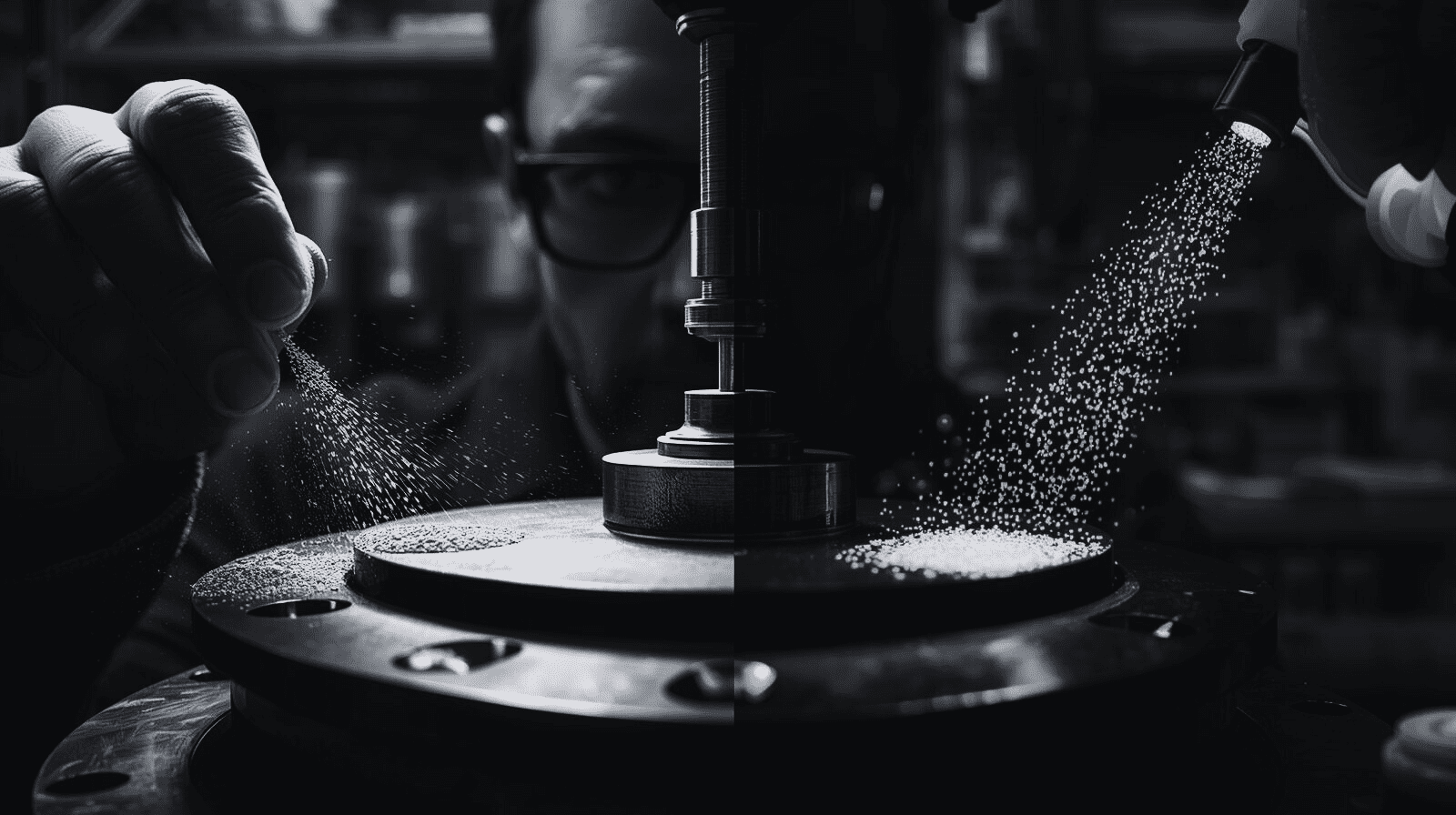
The dry method uses magnetic powder particles applied directly to the part during magnetization.
These particles adhere to the leakage field areas, forming indications visible to the inspector.

Main characteristics of the dry method

  • Ideal for field testing or inspections of large structures;
  • It eliminates the need for liquid vehicles, making the process portable and fast ;
  • Suitable for rough, uneven or complex geometric surfaces ;
  • It can be applied to parts at high temperatures (up to 180 °C).

Did you know?

Limitations of the dry method

  • Lower sensitivity than the wet method, especially in small discontinuities;
  • It can lead to uneven particle buildup if not applied properly;
  • The inspector needs experience to interpret the instructions.

Magnetic particle testing – wet method: precision and sensitivity

In wet spectroscopy , magnetic particles are suspended in water or oil , forming a homogeneous suspension applied to the surface during magnetization.
This technique offers greater particle mobility , resulting in improved sensitivity in detecting discontinuities.

Main characteristics of the wet method

  • Suitable for high-precision testing ;
  • It allows the use of fluorescent particles , inspected under UV-A light ;
  • It requires strict control of the suspension regarding concentration and contamination;
  • The measurements are verified using a pear-shaped decanter tube (ASTM E709).

For fluorescent particles , the ideal concentration is between 0.1 and 0.4 mL ; for colored
particles , between 1.2 and 2.4 mL , according to ASTM E709 and NM 342 .

Limitations of the wet method

  • Requires additional equipment (UV flashlight) for the fluorescent technique;
  • A darkened environment is required for fluorescent techniques;
  • Greater process control is needed (concentration and contamination).

Important notice:This article is for educational purposes only. The definition of the test method, technique, and parameters must be carried out by a Level 3 Inspector in a qualified and approved procedure.


Metal-Chek products in compliance with regulations

Metal-Chek offers complete solutions for magnetic particle testing, developed in accordance with the main international standards:

  • Colored and fluorescent magnetic particles (dry and wet methods);
  • Water-based suspension conditioners ;
  • High-opacity contrast inks for inspections under white light;
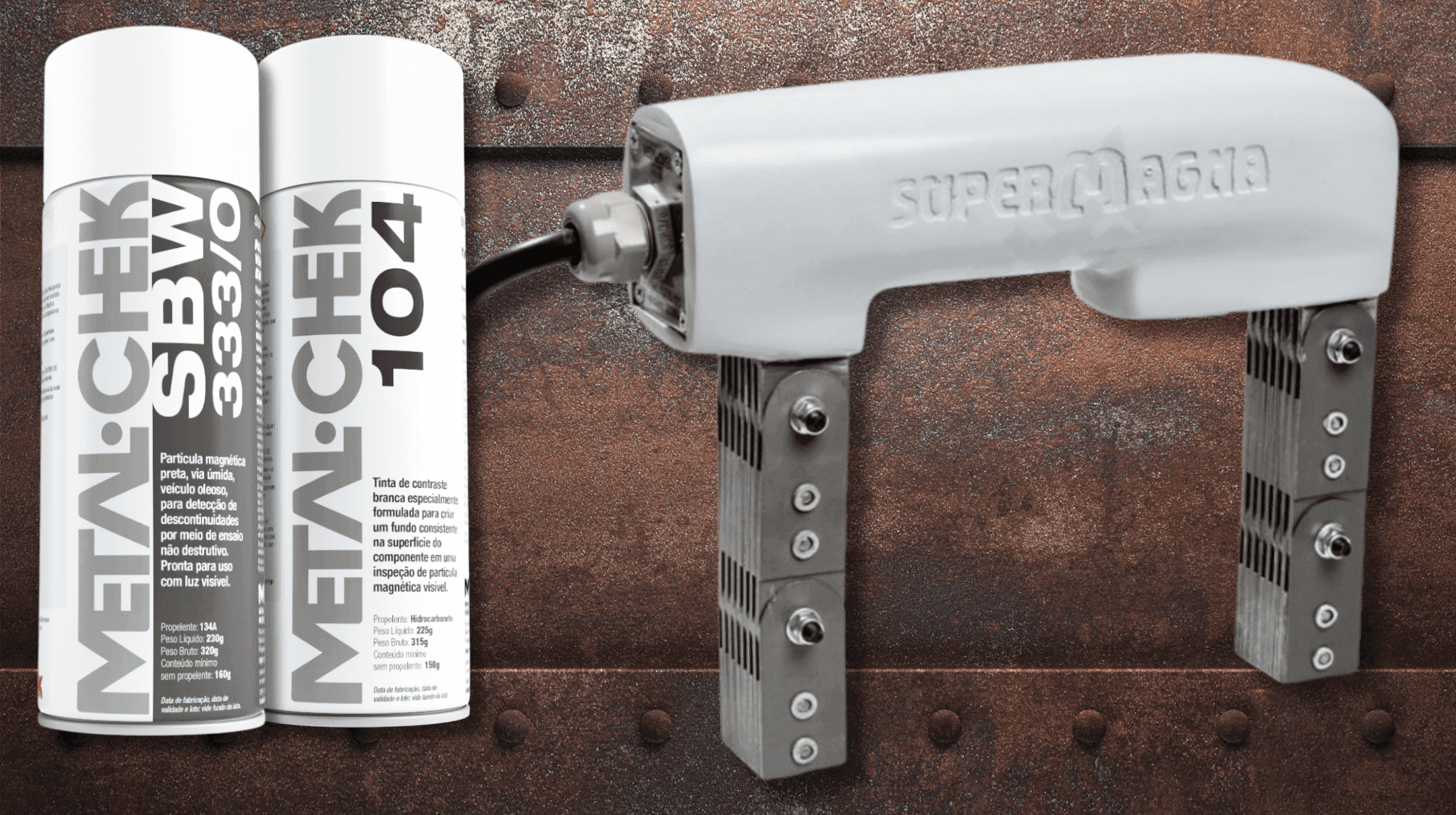
  • Supermagna HMM6 electromagnetic yokes , robust, portable and standard compliant.

All products are formulated to meet regulatory requirements, ensuring compliance, sensitivity, and repeatability of results.


When to apply each magnetic particle testing method

The dry and wet methods of magnetic particle testing are distinct, and their application should be based on the test conditions and procedural requirements.

Regardless of the method, using reliable products with proven quality is essential to ensure consistent and reproducible results — and that’s where Metal-Chek stands out.


Excellence in products for those seeking reliable results.

Metal-Chek provides complete END solutions: magnetic particles, contrast inks, conditioners, and electromagnetic yokes, developed according to the main ASTM, ASME, NM, and PETROBRAS standards, guaranteeing safety, precision, and technical compliance in every inspection.

Discover the complete Metal-Chek product line.

Contact  our team .

Follow @metalchek
Technical Standards Governing Penetrant and Magnetic Particle Testing

The importance of technical standards in Non-Destructive Testing

Non-destructive testing (END) is essential to ensure the integrity of equipment and components used in various industrial sectors.
Among the most widely used methods are liquid penetrant testing (LP) and magnetic particle testing (PM).

Both allow the identification of discontinuities that could compromise the safety and performance of metal structures, welds, shafts, or castings, etc.

To ensure the quality and standardization of results, there is a set of national and international technical standards that establish criteria for execution, materials, and test conditions.

Next, see what these rules are and what each one determines in summary.


ASTM E1417 – Standard Practice for Liquid Penetrant Testing

It is the main international standard for the Penetrant Testing method .
It defines the essential parameters for the safe and accurate execution of the test, including:

  • Classification of penetrants (fluorescent and colored);
  • removal methods (water washable, post-emulsifiable, solvent removable);
  • lighting and sensitivity requirements;
  • stages of the process, such as cleaning, penetration, and development.
  • process controls.

ISO 3452 – Non-Destructive Testing – Penetrant Testing

The ISO 3452 series establishes international standards for materials and equipment.
Among its main topics are:

  • Part 1: General principles;
  • Part 2: Penetrant material requirements;
  • Part 3: Reference blocks;
  • Part 4: Equipment;
  • Part 5: Requirements for liquid penetrant testing at temperatures above 50 °C.

NM 334 – Non-destructive testing — Penetrant testing — Discontinuity detection

Mercosur standard that defines the main requirements for LP inspections in the national context, including:

  • technical terminology and symbology;
  • test stages (pre-cleaning, application, penetration, removal, development and evaluation);
  • minimum lighting levels;

ASTM E165 – Standard Practice for Liquid Penetrant Testing for General Industr y

Standard that defines the general procedures and criteria for liquid penetrant testing (LP) in industrial applications.
Establishes requirements for:

  • Classification of penetrants (fluorescent or colored);
  • removal methods (water, solvent or post-emulsifiable);
  • Control of lighting, temperature, and penetration time;
  • Sensitivity testing and product quality control.

PETROBRAS N-1596

Define:

  • test parameters and minimum/maximum process times;
  • procedural requirements;
  • lighting conditions;
  • Product classification and traceability;
  • Requirements for staff execution and qualification.

PETROBRAS N-2370

Provides:

  • General guidelines for safety, documentation, and traceability;
  • Penetrant testing.

ASME V – Art. 6

An integral part of the ASME Boiler and Pressure Vessel Code (BPVC) , it defines the requirements for penetrant testing applied to boilers, pressure vessels, and pressurized equipment.
It contains:

  • Specifications for materials and equipment;
  • sensitivity check of the test system;
  • process control and inspection intervals;
  • Acceptance according to manufacturing codes.

ASTM E709 – Standard Guide for Magnetic Particle Testing

The principal international standard governing magnetic particle testing .
It establishes best practices and application guidelines for:

  • Magnetization techniques (yoke, electrodes, coil, center conductor and direct contact);
  • use of colored and fluorescent particles;
  • Electrical current control and field direction;
  • Verification of particle concentration and illumination (visible and UV).

ASTM E3024 – Standard Practice for Magnetic Particle Testing for General Industry

It complements ASTM E709 and provides specific instructions for inspections in general industry .


NM 342 – Non-destructive testing — Magnetic particles — Discontinuity detection

It establishes technical parameters for conducting the test in accordance with international standards:

  • Dry and wet application;
  • characteristics of magnetic particles and liquid vehicles;
  • Recommended concentration ranges for wet application (0.1 to 0.4 mL for fluorescent and 1.2 to 2.4 mL for colored);
  • Light intensity control for visible and UV-A light.

ASTM E1444 – Standard Practice for Liquid Penetrant Testing for Aerospace

Specifically for the aeronautical and aerospace sector , it defines detailed practices for magnetic particle (PM) testing .
It establishes:

  • requirements for magnetic materials and vehicles;
  • concentration limits and bath control;
  • UV-A and white light checks;
  • Strict calibration and acceptance criteria.

PETROBRAS N-1598

It defines the criteria for performing the PM method on ferromagnetic materials.
It covers:

  • magnetization techniques;
  • UV lighting requirements and field strength;
  • calibration procedures.

ASME V – Art. 7

Part of the ASME Boiler and Pressure Vessel Code , it defines the requirements for magnetic particle testing of pressurized equipment and welded components.
It covers:

  • Types of electric current and magnetization techniques;
  • magnetic field intensity control;
  • detection methods;
  • Acceptance and qualification criteria for the testing system.

ISO 9934 – Non-Destructive Testing – Magnetic Particle Testing

The ISO 9934 series establishes international standards for materials and equipment.
Among its main topics are:

  • Part 1: General principles;
  • Part 2: Detection method;
  • Part 3: Equipment;

Importance of technical standards for the reliability of END (Non-Destructive Testing).

The standards governing liquid penetrant and magnetic particle methods are the technical basis that ensures reliability and regulation  of Non-Destructive Testing.
They guide everything from product development to practical application in the industrial environment, ensuring quality, safety, and standardization in every inspection.

Knowing these standards is essential for anyone working in quality control, maintenance, and inspection — whether in heavy industry, petrochemicals, aeronautics, or metallurgy.


Important notice:

This content is for educational purposes only. The application of the test methods and parameters must follow a qualified procedure approved by a Level 3 Inspector .


Solution in Non-Destructive Testing

Metal-Chek provides complete END solutions: penetrant liquids , magnetic particles , yoke and accessories , developed according to the main ASTM, ISO , ASME, NM, PETROBRAS standards, guaranteeing quality, safety and technical compliance in every inspection.

Discover the complete Metal-Chek product line.

Contact our team.

Follow @metalchek

Translate