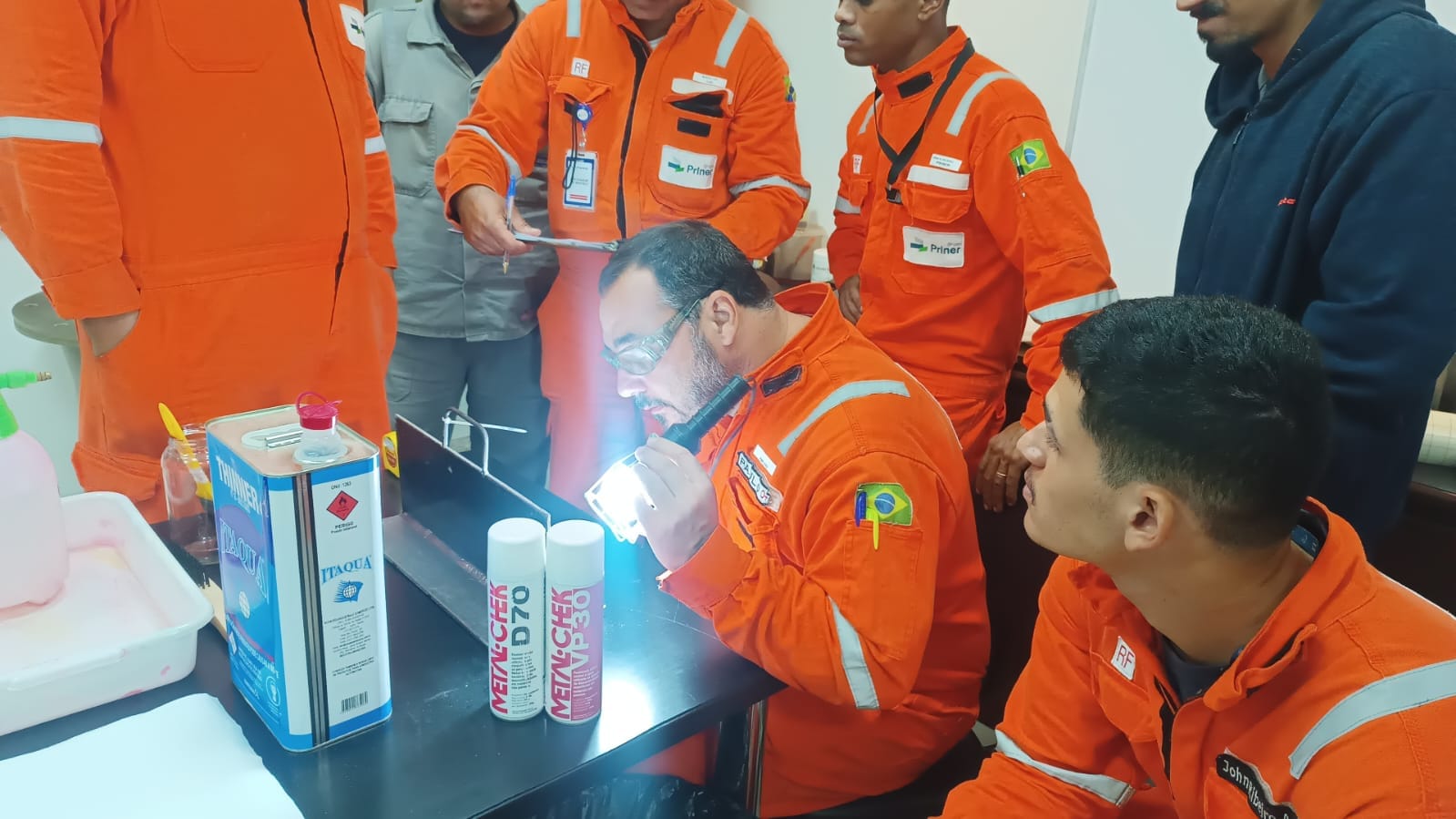
Welding Inspection: How to Avoid False Positives with the Penetrant Testing Method
Liquid penetrant (LP) inspection is widely used to detect surface-open discontinuities in welded joints. However, this type of inspection presents a recurring challenge: false positives. Often, indications observed during the test do not correspond to real defects, but rather to artifacts caused by inadequate surface conditions or process execution. Based on ASTM E1417, ISO 3452-1, and ABNT NBR 15808 standards, this article explores how to avoid these interpretative errors.
Sources of False Positives
Welded surfaces often exhibit roughness, weld spatter, and metallic residue that retains the penetrant unevenly, creating marks that can be mistaken for discontinuities. To avoid this, surface preparation is essential. Removing slag, oxides, and contaminants by light blasting or chemical cleaning according to ISO 8501-1 is a critical step before product application.
Another important factor is the correct choice of penetrant type and sensitivity. On rough surfaces, highly sensitive products can cause background saturation, making interpretation difficult. In these cases, the use of penetrants with intermediate sensitivity (level 2 or 3) is recommended. Furthermore, the lighting must comply with ISO 3059, especially in industrial environments with varying levels of natural light. White light above 1000 lux or UV-A light between 1000 and 5000 μW/cm² is essential to ensure adequate visibility of the indications.
Removing excess penetrant is also a critical step. If done excessively, it can erase a true indication. If insufficient, it can create a “colored background” and mask defects. The developer application must be uniform, and the development time must be respected according to the type used: dry, wet, or non-aqueous.
Finally, the inspector’s training makes all the difference. A professional trained according to ISO 9712 will have greater ability to distinguish between a true discontinuity and a surface artifact. Investing in training and continuous review of internal procedures contributes significantly to the quality and reliability of inspections.
Minimizing false positives in liquid penetrant testing (LP) of welds depends on three pillars: proper surface preparation, correct execution of the process, and professional qualification. These precautions increase the reliability of the test, reduce rework, and ensure more accurate decisions regarding the integrity of the welds being evaluated.
The accuracy of liquid penetrant (LP) weld inspection depends directly on the quality of surface preparation, the correct choice of penetrant, and the inspector’s experience. Standardizing the process according to international norms reduces the incidence of false positives and ensures greater reliability in acceptance or rejection decisions.
