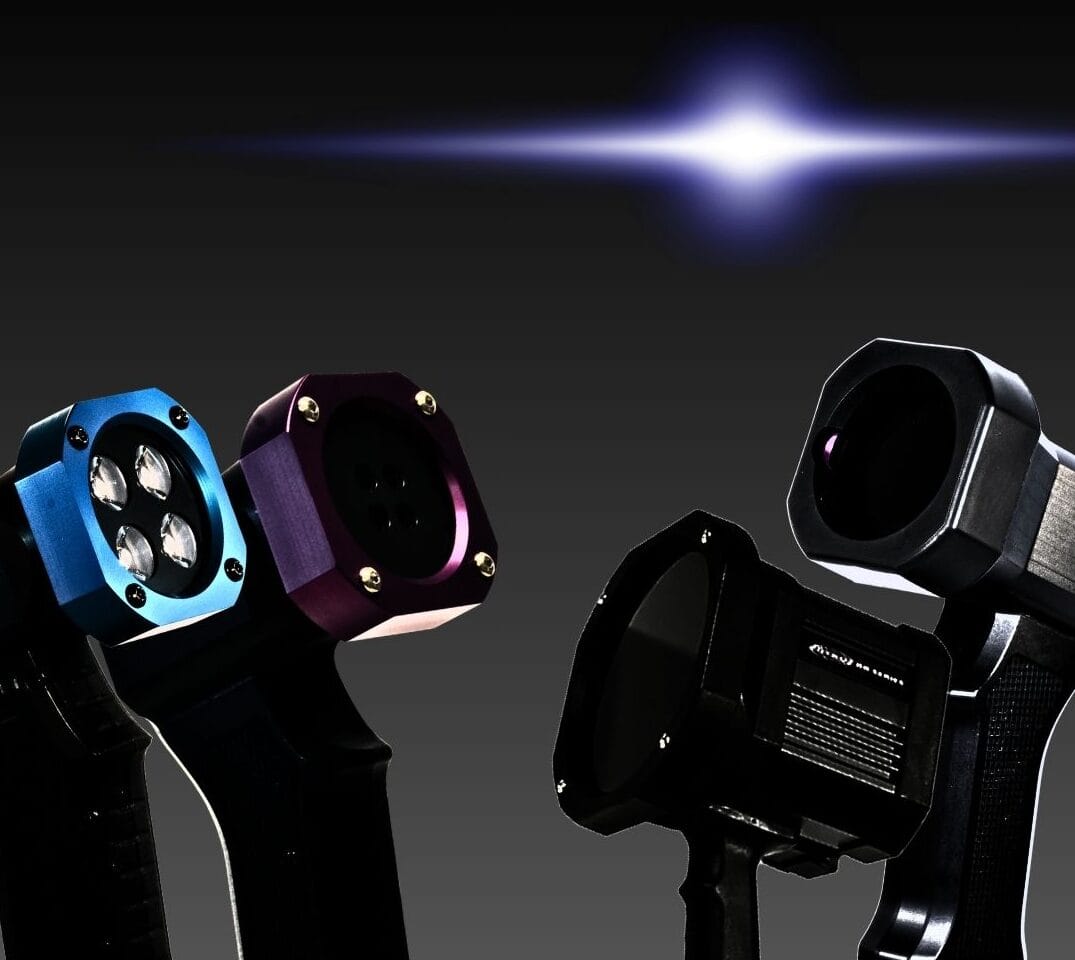
Tag Lighy Fixtures

ASTM E3022-25: Why This Standard Is Essential

In Fluorescent Penetrant (LP) and Fluorescent Magnetic Particle (FM) tests , UV-A light is not just an accessory—it is a critical detection tool. The quality of illumination used by the inspector defines what is seen… and what can go unnoticed.

To ensure that the UV-A source truly offers stability, safety, and adequate performance, the industry has adopted ASTM E3022-25, now considered the most rigorous technical standard in the world for UV-A LED luminaires used in END (Non-Destructive Testing).


Why was ASTM E3022-25 created?

ASTM E3022-25 was created precisely to establish minimum and verifiable requirements that define when a UV-A LED light fixture is truly suitable for industrial inspections, especially in critical applications such as:

  • Aerospace
  • Automotive
  • Oil & Gas
  • Industrial maintenance
  • Welding and structural integrity

In this way , the standard ensures that the luminaire operates within the necessary parameters, guaranteeing that the fluorescence of the penetrants and particles is visible and reliable.


What does ASTM E3022-25 require in practice?

The standard dictates that the luminaire must be tested as a complete unit , not by individual components. This eliminates the possibility of partial tests that do not represent actual performance.

Main requirements that a UV-A luminaire must meet:

Maximum IrradianceFWHM
Irradiance Profile (Beam Profile)LWHM
Minimum working distanceExcitation Irradiance
Thermal stabilityCurrent variation
Emission spectrumTypical battery discharge time*
Peak wavelengthFilter transmittance

* If applicable

This eliminates variations between units and ensures repeatability in the field.

Why is this standard important for safety and for the outcome of the inspection?

A non-compliant light fixture can:

  • Reduce the useful inspection area;
  • Change the intensity without the operator noticing;
  • To utilize a wavelength and have a broad spectrum and reduce fluorescence;
  • Increase the risk of undetected failures;
  • Generating non-conformities in technical audits (NADCAP, etc.).

For industries that work with critical components — such as structural welds, shafts, bearings, rotors, aeronautical components, and automotive parts — this difference is crucial.


Relationship of ASTM E3022-25 with other END standards

The standard is cited and used as a reference in several technical documents, such as:

  • ASTM E1417, ASTM E165 (Liquid Penetrant)
  • ASTM E1444, ASTM E709, ASTM E3024 (Magnetic Particles)
  • ISO 3059 (Lighting requirements for END)

This reinforces the importance of E3022-25 as a quality base for any UV-A lamp used professionally in END (Non-Destructive Testing).


Final message for inspectors, engineers, and quality managers.

ASTM E3022-25 is not merely a regulatory formality.

It represents a commitment to:

Reliability of the indications

  • Operational safety
  • Standardization of inspection
  • Reproducibility of results
  • Compliance with audits

Thus , by using UV-A lamps certified according to this standard, the professional reduces risks, in addition to increasing precision and strengthening the entire quality chain of Non-Destructive Testing.


Stay tuned for updates!

We will soon be presenting important news related to our line of lighting fixtures for END (Non-Destructive Testing).
Follow our blog and social media channels to stay updated on upcoming releases.
Contact our technical consultants .


Excellence in products for those seeking reliable results.

Metal-Chek offers complete solutions for Non-Destructive Testing, developed according to the main technical standards of the sector.
Count on our line of consumables, accessories, and equipment designed to guarantee safety, precision, and compliance in every inspection .

Portability and Efficiency: Advances in UV Lighting

Industrial maintenance is undergoing a silent transformation—and one that is extremely relevant for those working in Non-Destructive Testing (END). UV lamps, essential for Liquid Penetrant (LP) and Magnetic Particle (MP) inspections , have evolved significantly in recent decades, driven mainly by the consolidation of UV LED technology. This change directly impacts the efficiency, quality, and reliability of inspections. More than that, it redefines the role of the inspector, who now has lighter, more durable, and more precise tools to perform critical analyses.


From vapor lamps to UV LEDs: the new era of lighting for END

For many years, mercury vapor-based UV lamps dominated the scene. Although functional, they had clear limitations: intense heating, fragility, high energy consumption, and unstable light.

With the arrival of UV LED lighting , the landscape changed.

Why does UV LED represent a technological leap?

  • Stable and instant lighting , with no warm-up time.
  • Much longer lifespan , reducing replacements and maintenance.
  • Superior energy efficiency , with lower consumption and greater range in battery-powered versions.
  • Increased mechanical strength , reducing field failures.
  • The absence of toxic materials makes the equipment safer and more sustainable.

For those who inspect welds, critical parts, and structural components, this stability and precision are fundamental.


Portability: real productivity for those who work in the field

The inspector rarely works in comfortable spaces. Most inspections take place in hard-to-reach areas, elevated structures, confined spaces, or extensive pipelines.

The advancement of LEDs has allowed UV lamps to become:

  • lighter ,
  • more compact ,
  • more ergonomic ,
  • more resistant ,
  • and with greater operational autonomy .

Direct impacts on the inspector’s routine.

  • Less fatigue during long shifts.
  • Greater agility in accessing critical points.
  • Less reliance on cables or external power sources.
  • Greater precision in illuminating the inspected area.
  • Reliability even in harsh environments.

Portability is no longer a “plus” but a strategic component of operational efficiency.


Durability and energy efficiency: savings that translate into performance

While traditional light bulbs frequently burned out, high-performance LEDs brought consistency and cost reduction.

Main benefits:

  • Less maintenance and less downtime.
  • Extended autonomy with long-lasting batteries.
  • Reduced overall costs thanks to a longer lifespan.
  • Stable UV intensity , ensuring adequate sensitivity in both low-level and mid-life modes.

For ongoing inspections and critical operations, this combination is indispensable.


Regulatory compliance: the importance of ASTM E3022

In END (Non-Destructive Testing), technology alone is not enough: it is necessary to meet the correct standards. ASTM E3022 is the international reference that establishes the minimum requirements for UV LED luminaires used in:

  • Magnetic Particle (MP) Testing
  • Penetrant Testing (PT)

The standard requires rigorous criteria, such as:

  • minimum UV intensity suitable for the method;
  • Uniformity of lighting in the inspection area;
  • Visible radiation control;
  • thermal stability;
  • Mechanical strength suitable for industrial use.

Why is this fundamental?

Because lighting failures mean detection failures.
Without compliance with ASTM E3022, there are real risks:

  • indications that do not appear;
  • Unnecessary rework;
  • inconsistent results;
  • Problems in audits and certifications;
  • security commitments.

The standard ensures that the inspector works with adequate lighting to detect even the most subtle indications.


The practical impact of these advances on the quality of inspections

The evolution of UV LED lighting directly influences:

  • The accuracy of discontinuity detection;
  • the pace at which inspections are carried out;
  • The ergonomics of fieldwork;
  • The safety and traceability of the process;
  • The reliability of the results delivered.

In sectors such as oil and gas, automotive, aerospace, and metalworking, this translates to lower operational risk and greater control over asset integrity .


UV LED lighting as a protagonist in the new era of END

The combination of portability, energy efficiency, durability, and regulatory compliance has transformed UV LED luminaires into essential tools for modern inspections.

Technology not only makes the inspector’s job easier — it raises the quality of the entire industrial maintenance chain.


Stay tuned for updates!

We will soon be presenting important news related to our line of lighting fixtures for END (Non-Destructive Testing).
Follow the blog and our social media to stay updated on the launch.
Technical lighting, precision, and innovation for those who demand reliable results.

Translate