Archives April 2026

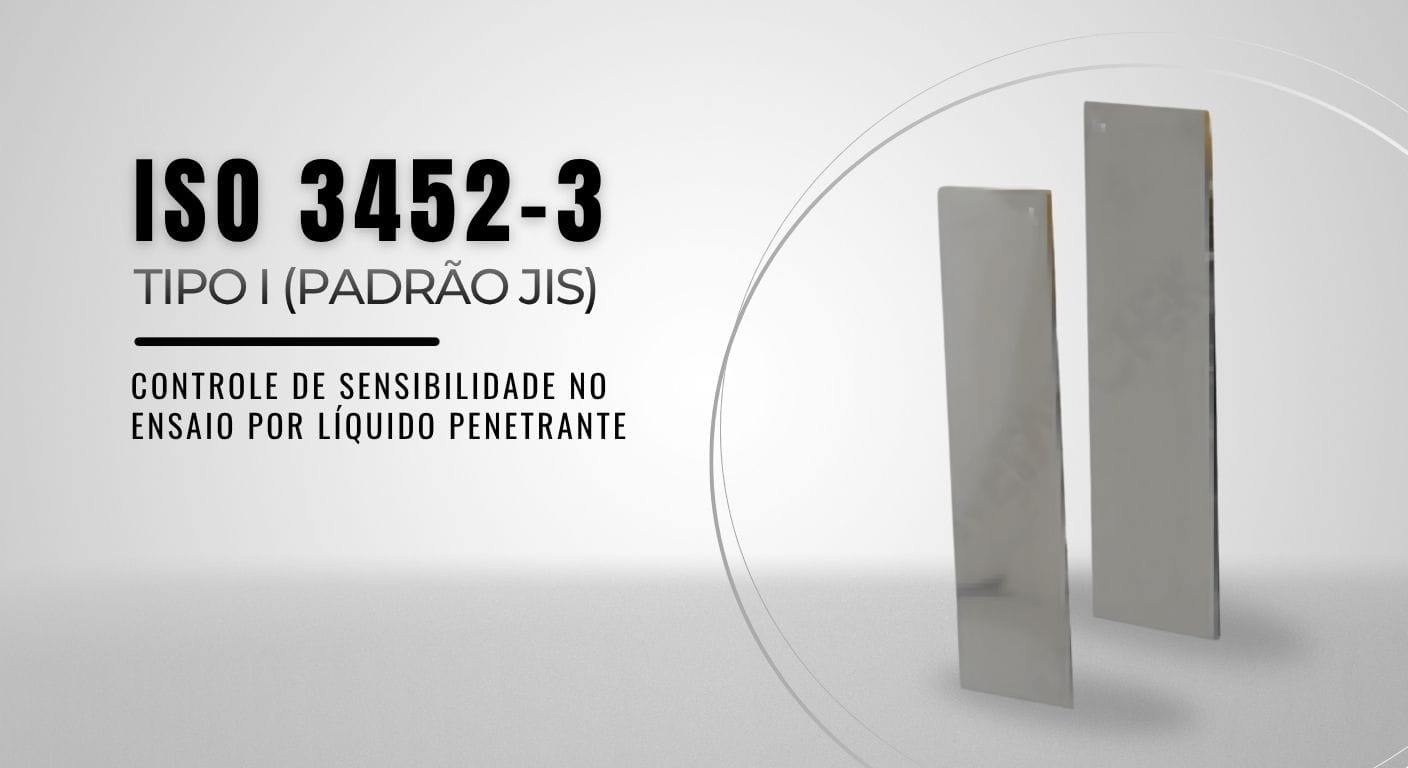
ISO 3452-3 Type I (JIS Standard)

The reliability of a liquid penetrant test is directly related to the sensitivity of the inspection system , that is, its ability to detect discontinuities of different dimensions.

To guarantee this performance, international standards establish the use of standardized reference blocks , used for sensitivity verification and quality control of the test.

Among these standards, ISO 3452-3 Type I stands out .


What is the ISO 3452-3 Type I standard?

ISO 3452-3 defines requirements for reference blocks used in liquid penetrant testing.

The Type I  standard consists of a metal plate with controlled artificial cracks , used to evaluate the performance of the penetrating system.

This pattern allows you to verify:

• the sensitivity of the assay
• the ability to reveal the indications
• the performance of the system composed of penetrant, remover and developer


Applications of the JIS standard

The ISO 3452-3 Type I standard is primarily used in two situations:

1) Materials acceptance test

Allows you to check the performance of new batches of:

• penetrants
• removers
• developers

This control ensures that the materials meet the expected level of sensitivity.

2) Verification of the test’s sensitivity

Used to confirm that the inspection system maintains adequate performance throughout its use.


JIS Standard Types

The patterns are available with different levels of depth:

• 10 µm
• 20 µm
• 30 µm
• 50 µm

The selection of the standard must be aligned with the level of sensitivity required by the application or as defined in a qualified procedure approved by a Level III inspector.


Relationship to the type of penetrant

The choice of pattern should take into account the type of penetrant used:

• Fluorescent penetrants (Type I)
→ higher sensitivity, typically evaluated with 10 µm or 20 µm standards
• Visible penetrants (Type II)
→ lower sensitivity, typically evaluated with 30 µm or 50 µm standards

This relationship allows for a correct evaluation of the performance of penetrant materials.


Importance of sensitivity control

Verifying sensitivity is essential to ensure the reliability of the test.

The absence of this control can result in:

• Failure to detect relevant discontinuities
• Inconsistency in results
• Loss of process reliability

The use of reference standards allows for the validation of system performance and maintains the repeatability of inspections.


The use of the ISO 3452-3 Type I standard is an essential practice for verifying performance in Liquid Penetrant (LP) testing .

The correct application of these standards contributes to the reliability of the process, meeting regulatory requirements and ensuring the quality of the inspections performed.


Excellence in products for those seeking reliable results.

Metal -Chek provides complete solutions for Non-Destructive Testing: penetrant liquids, removers, developers, lighting fixtures and accessories, developed according to the main ASTM, ISO, ASME, NM and PETROBRAS standards , guaranteeing quality, safety and technical compliance in every inspection.

Speak with our  technical consultants  and find the ideal solution for your process.

Visit our  blog  and check out other technical content.

Discover our  complete product line .

Follow Metal-Chek on  Instagram ,  YouTube , Facebook  , and  LinkedIn.

ASME V Art. 6 Appendix II: Liquid Penetrant Contaminants

In critical industrial applications, especially those involving materials such as austenitic stainless steels, nickel-based alloys, and titanium , liquid penetrant testing requires not only sensitivity but also rigorous contaminant control .

The presence of elements such as sulfur, chlorine, and fluorine can compromise the integrity of the inspected material.

In this context, ASME BPVC Section V – Article 6, Appendix II establishes specific requirements for controlling these contaminants in the materials used in the test.


ASME V Requirements Art. 6 – Appendix II

Appendix II defines criteria for controlling contaminants in materials used in liquid penetrant testing, especially in sensitive materials.

Normal:

• For nickel-based alloys, the sulfur content must be controlled.
• For austenitic, duplex, and titanium stainless steels, chlorine and fluorine must be controlled.
• The maximum permitted limit for these contaminants is 0.1% by weight.

Furthermore, the standard establishes that:

• Penetrant materials must be analyzed by batch.
• Results must be documented and certificates of analysis issued.
• Certificates must contain batch identification and test results.


Importance of contaminant control

Controlling these elements is essential to avoid undesirable effects during and after the inspection.

Among the main risks associated with the presence of contaminants are:

• Stress corrosion;
• Alteration of material properties
• Surface contamination
• Non-compliance with regulatory requirements

These factors can compromise both the integrity of the component and the validity of the inspection performed.


Critical applications

Contaminant control is particularly relevant in sectors where structural integrity is critical, such as:

• Oil and gas industry
• Aeronautical sector
• Nuclear industry
• Boilers and pressure vessels


Certification and traceability

The standard requires that the materials used in the test have certification with batch traceability.

This documentation should include:

• Results of chemical analyses
• Product batch identification
• Proof of compliance with established limits


Proper selection of consumables

The choice of materials used in liquid penetrant testing should consider not only performance but also compliance with regulatory requirements.

This includes:

• penetrants
• removers
• developers

Using products with contaminant control and proper certification contributes to:

• Preserve the integrity of the inspected material
• Meet regulatory requirements
• Ensure consistency in results

Metal-Chek supplies consumables for liquid penetrant testing developed according to international standards, with contaminant control and batch traceability.


Final considerations

Meeting the requirements of ASME V Art. 6 Appendix II is fundamental in applications involving materials that require contaminant control.

Contaminant control should be considered an integral part of the inspection process, contributing to the safety, reliability, and technical compliance of the tests performed.


Excellence in products for those seeking reliable results.

Metal -Chek provides complete solutions for Non-Destructive Testing: penetrant liquids, magnetic particles, removers, developers, lighting fixtures and accessories, developed according to the main ASTM, ISO, ASME, NM and PETROBRAS standards , guaranteeing quality, safety and technical compliance in every inspection.

Speak with our  technical consultants  and find the ideal solution for your process.

Visit our  blog  and check out other technical content.

Discover our  complete product line .

Follow Metal-Chek on  Instagram ,  Facebook  , and  LinkedIn.

Translate