How to Interpret Indications in Magnetic Particle Testing: A Guide for Inspectors
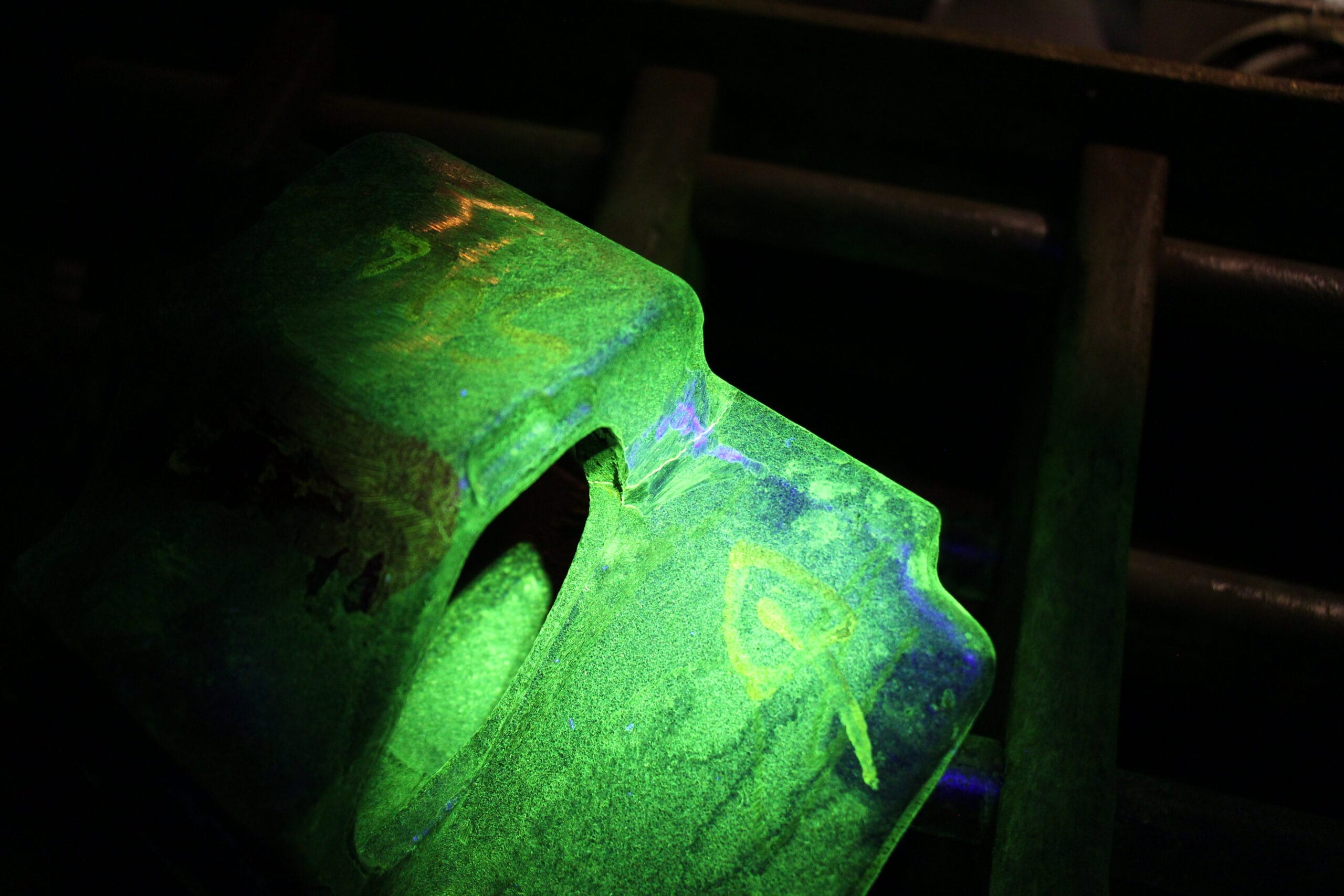
Interpreting the readings obtained during a magnetic particle test is one of the most critical points in the process, especially when dealing with high-responsibility parts. Knowing how to differentiate between a relevant indication (a real defect) and an irrelevant indication (caused by geometry, field overlap, or contamination) is what guarantees the reliability of the evaluation and avoids unnecessary rejections or in-service failures.
The ASTM E1444 standard, as well as ISO 9934-1, provides guidelines for identifying and classifying markings. According to these standards, a relevant marking is one that has sufficient extent, shape, and contrast to raise doubts about the integrity of the part. Irrelevant markings, on the other hand, typically appear in predictable locations such as holes, recesses, or areas of magnetic field concentration.
Furthermore, it is necessary to consider:
- Type of current used (direct or alternating);
- The direction of the applied field;
- The presence of residual fields. Inspectors should be alert to typical failure patterns, such as cracks parallel to the weld bead, laminations, non-metallic inclusions, or repetitive stress fatigue.
Reference photographs, comparison blocks, and previous reports can be used to aid in the decision.
Another important factor is documentation: all relevant information should be recorded with a description of the location, type of defect and, if possible, an image. Traceability is required by quality standards such as ISO 9001 and ASME.
Finally, the inspector’s qualification according to ISO 9712 is essential for them to have the technical expertise, critical thinking skills, and practical ability to correctly evaluate the test results.
The correct interpretation of the indications is not just a step in the PM process; it is the bridge between the technical test and the decision to continue or repair a component. Mastering this step reduces operational risks, strengthens asset safety, and generates cost savings for the industry.
