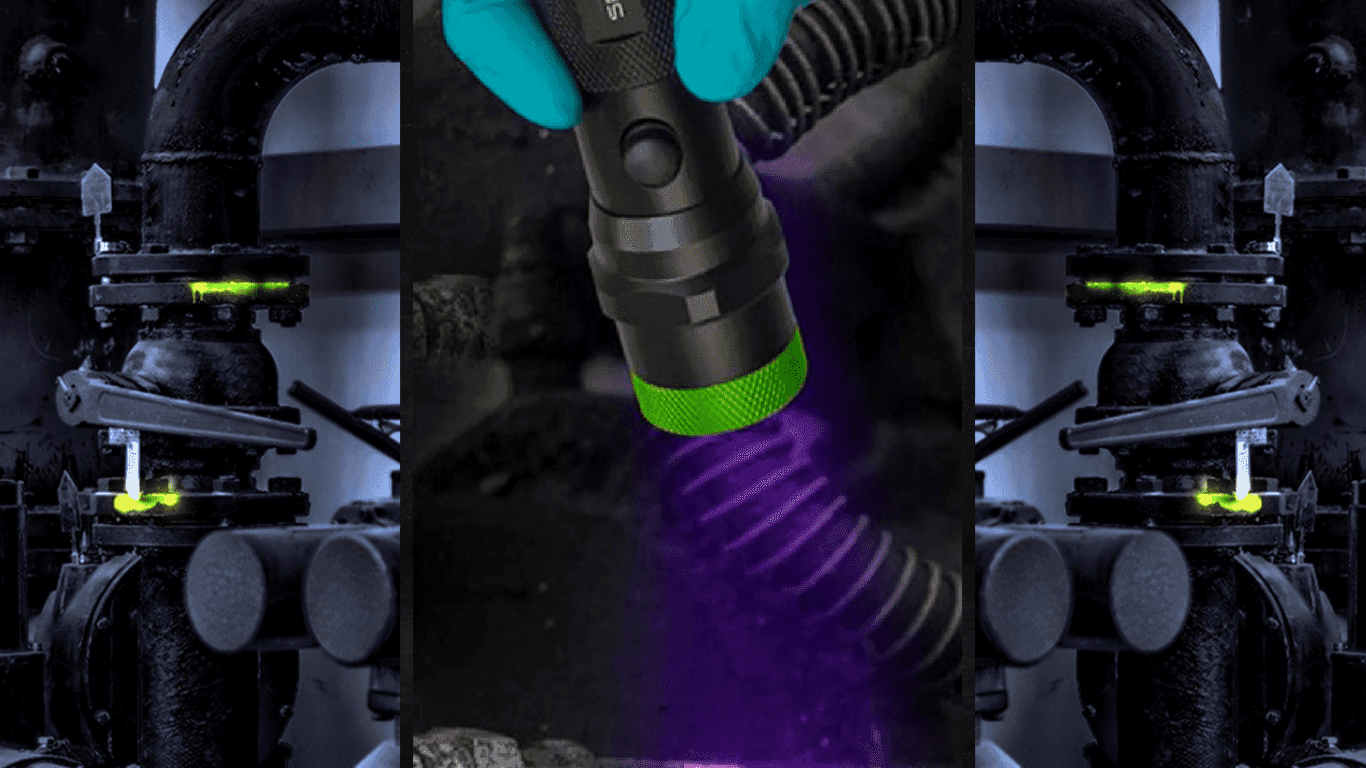
Industrial Leak Detection with Fluorescent Additives and UV Light: A Non-Destructive and Efficient Method
Industrial leaks are not just an operational headache. They can compromise a plant’s safety, productivity, and environmental compliance. Therefore, early leak detection is an essential practice for any modern industry, especially in contexts like Industry 4.0, where continuous monitoring and predictive maintenance are key to efficiency.
In this article, we will explore one of the main methods for detecting industrial leaks, focusing on non-destructive techniques based on the use of fluorescent additives and UV flashlights. The goal is to provide a comprehensive, technical, and accessible overview for professionals working in industrial maintenance, inspection, and sectors where operational reliability is non-negotiable.
Why is accurate leak detection vital?
Before we delve into the method, it’s worth reiterating: leaks can cause significant damage. We’re talking about:
- Loss of industrial fluids (oil, gas, water, compressed air, refrigerant, among others);
- Increased operating costs;
- Risks of fire or contamination;
- Damage to equipment and structures;
- Production interruptions;
- Legal and environmental non-conformities.
In a scenario where predictive maintenance is increasingly integrated into industrial strategies, the use of non-destructive testing (END) to identify and correct leaks has become a competitive differentiator.
The technology of fluorescent additives
Detection with fluorescent dyes is one of the safest, simplest, and most effective techniques for identifying leaks. The fluorescent additive works effectively in any closed circulatory system where liquids are used for lubrication, hydraulics, cooling control, and fuel systems.
The method involves adding a fluorescent additive — usually a colored liquid miscible with the system fluid (such as oil, water, fuel, or coolant) — which concentrates at the leak points. When exposed to ultraviolet (UV) light, this additive emits intense fluorescence, making even the smallest leaks visible.
How the method works:
- Fluorescent dye is added to the system to be inspected (pipes, tanks, heat exchangers, radiators, hydraulic systems, etc.).
- After a period of operation, the system is inspected with a UV flashlight .
- Leaks are visually identified as bright spots, usually in shades of green or yellow.
Advantages:
- Non-destructive method;
- Affordable cost;
- Quick and visual detection;
- Excellent for small leaks;
- Compatible with various types of fluids.
Typical applications:
- Industrial and automotive refrigeration systems;
- Oil pipelines;
- Plumbing installations;
- Reservoirs;
- Air conditioning equipment (HVAC/R).
- Fuel lines;
The role of UV flashlights
UV flashlights are indispensable tools in this process. Their main function is to emit ultraviolet radiation, in the 365nm range, to excite the fluorescent molecules of the additive, making the leak visible to the naked eye.
Characteristics of UV flashlights:
- Laptops;
- Battery powered;
- IP certification;
- Specific power and wavelength for greater visual contrast;
- Long range;
| Criterion | Fluorescent + UV Additive |
| Type of leak detected | Visible fluid (oil, water, fuel) |
| Cost | Low |
| Ease of use | High |
| Requires system shutdown. | In some cases |
| Ideal for predictive maintenance. | Yes |
| Digital data generation | No |
Good practices in leak inspection
- Use certified additives that are compatible with the system fluid;
- Follow the manufacturer’s instructions regarding concentration and circulation time;
- Use UV flashlights with the appropriate wavelength;
- Document the identified leak points with photos and technical reports.
Safety and environment
The choice of method should always consider environmental and health impacts. High-quality fluorescent additives have NSF and OEM Grade certification, but their disposal must comply with local environmental regulations. The use of UV flashlights must also follow safety standards, avoiding prolonged direct exposure to radiation.
Conclusion: technology combined with intelligent maintenance
Leak detection using fluorescent additives and UV flashlights represents an efficient, affordable, and visually powerful solution for maintaining the integrity of industrial systems.
If your company operates in the industrial and commercial sectors, industrial maintenance, inspection, and welding, incorporating these practices can represent significant cost savings, in addition to ensuring compliance, safety, and performance.
Want to know which fluorescent additives and UV luminaires are ideal for your type of application? Talk to the Metal -Chek technical team — a national specialist in solutions for Non-Destructive Testing .
Contact us: (11) 3515-5287
Follow us on Instagram: @metalchek
