How to Perform an Efficient Magnetic Particle Inspection: A Guide for Professionals
Discover how to plan and execute magnetic particle inspections, ensuring speed, reliability, and compliance with technical standards.
Industrial inspections can present challenges such as lack of infrastructure, space limitations, adverse conditions, and the need for fast and reliable results.
In this context, Non-Destructive Testing (END) using magnetic particles (MP) stands out as a practical solution for detecting surface discontinuities in ferromagnetic materials .
This practical guide is aimed at maintenance professionals, inspectors, and engineers, showing how to perform magnetic particle inspections efficiently, safely, and in compliance with regulations, even outside of controlled laboratory environments.
Surface Preparation
One of the biggest challenges in inspections is dealing with surfaces contaminated by grease, oil, welding spatter, or oxidation. Proper area preparation is essential to avoid false readings.
Recommended techniques:
• Steel brush (manual or rotary): quick removal of oxidation from welds and metal structures.
• Grinding: suitable for removing coatings and persistent oxidation.
• Solvents and clean cloths: remove grease and oils.
The better the preparation, the greater the reliability of the inspection.
Choice of Technique
The type of application of magnetic particles should consider environmental conditions, available time, and required sensitivity.
- Dry process:
Advantages → ideal for surfaces with high temperatures
Limitations → lower sensitivity to small discontinuities
- Wet method (water or oil):
Advantages → high sensitivity, suitable for detecting small discontinuities.
- Colored wet process
Advantages → visible under white light, no need for special lighting fixtures.
Limitations → operating temperature
- Fluorescent wet particles:
Advantages → maximum sensitivity under UV-A light.
Limitations → operating temperature, visible only under UV-A light.
Safety in Confined Spaces
Inspections of tanks, vessels, and confined structures require additional safety measures:
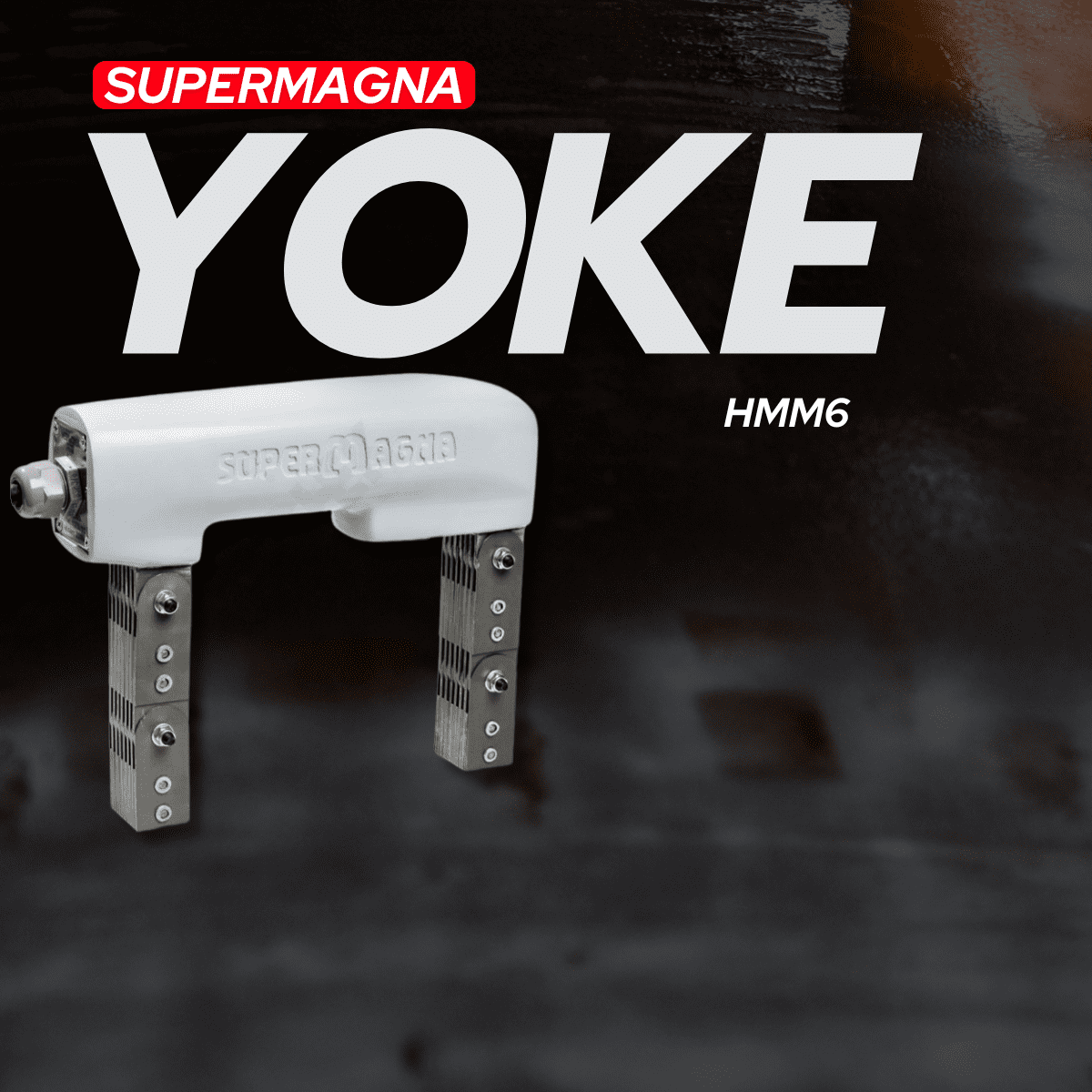
- Use portable and robust equipment , such as the Supermagna Yoke HMM6 , which works in different positions and does not conduct current through the workpiece.
- Respect occupational safety standards (e.g., NR-33 – Safety in Confined Spaces).
Choosing robust equipment is crucial for reducing risks and increasing reliability in challenging environments.
Technical Standards Governing Testing
Magnetic particle inspection can follow recognized standards to ensure reliable results:
- ASTM E709
- ISO 9934 (1 to 2)
- PETROBRAS N-1598
- ASME Section V, Article 7
Recommended Equipment for Inspections
For magnetic particle inspections, the ideal solution is to use equipment that combines durability, safety, and regulatory compliance.
The Supermagna Yoke HMM6, for example, is designed to meet these needs:
- Portable and robust.
- Safe in potentially explosive atmospheres.
- Meets ASTM, ISO, ASME and PETROBRAS standards.
- Suitable for inspections of welds, metal structures, castings, forgings, etc.
Magnetic particle inspection is a strategic tool for industrial maintenance. When performed correctly — with proper surface preparation, appropriate technique selection, and the use of reliable equipment — it ensures operational safety, regulatory compliance, and cost reduction.
If your company operates in sectors such as oil & gas, energy, automotive or metallurgical, the Metal-Chek Supermagna Yoke HMM6 is the ideal solution to guarantee reliable results within standards.
Speak with our technical team.
Follow us on: @metalchek
