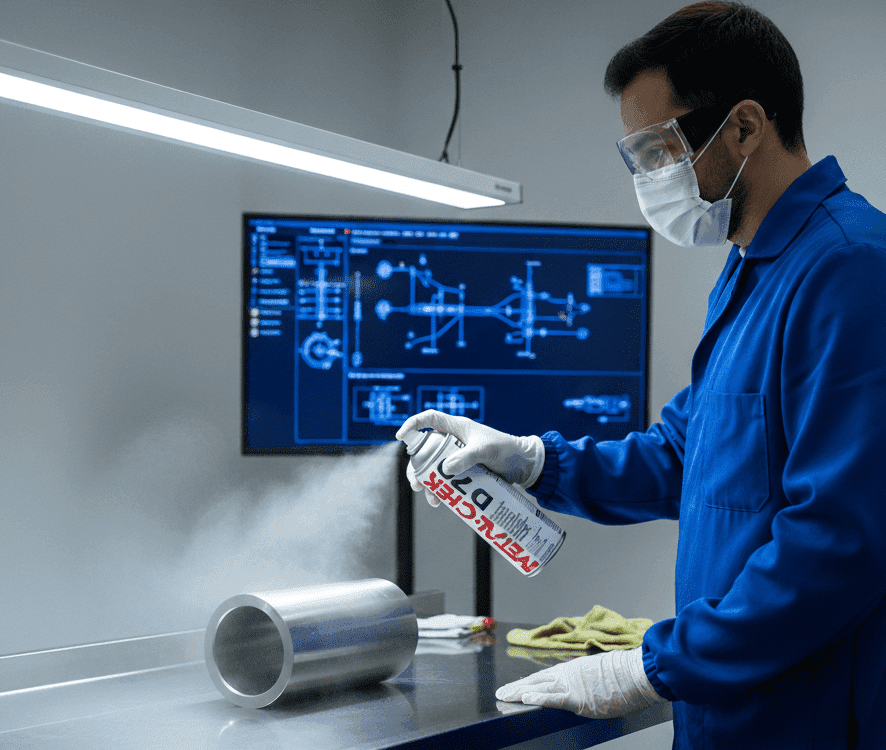
Revealing: Types and Differences
In Liquid Penetrant Testing (LP), the developer plays an essential role: it is what makes the indications of discontinuities visible. Its function is to form a thin, uniform layer on the clean, dry surface, acting by reverse capillary action —promoting the return of the penetrant retained in the discontinuities to the surface, where the visible indication is formed for evaluation under white/visible light (for visible penetrants) or ultraviolet UV-A light (for fluorescent penetrants), allowing for a clear and reliable assessment.
More than just a product, the developer is a crucial factor in the sensitivity and reliability of the test. Therefore, understanding its variations and applications is fundamental for efficient inspection that complies with technical standards.
Types of Developer and Their Differences
Developers are classified according to their form, and the correct choice depends on the type of penetrant and the inspection environment.
The main categories are listed below:
1. Dry Developer
Dry developer consists of fine powder and forms a light, absorbent film. It is applied to the dry surface after the penetrant has been removed.
- Application: by immersion, dust chamber, electrostatic spray or spraying.
- Advantages: high sensitivity and solvent-free; ideal for fluorescent penetrants.
- Metal-Chek product: D72 Powder Developer , ready to use, non-flammable and easy to remove.
2. Aqueous Developer
Developer prepared in aqueous solution, which forms a uniform white film after drying.
- Application: by immersion or spraying.
- Advantages: homogeneous coverage, easy dispersion, and concentration control.
- Metal-Chek product: D76 Water-Soluble Developer , diluted from 15 to 60 g/L of water, indicated for use with fluorescent penetrants.
3. Non-Aqueous Developer
It consists of fine white particles suspended in solvent, forming an opaque, high-contrast white background. It is the most common type in the field, especially in visible penetrant inspections.
- Application: Apply in a thin, uniform layer by spraying (aerosol or compressed air gun).
- Advantages: quick drying, excellent contrast, and easy removal.
- Metal-Chek product: D70 Non-Aqueous Developer , available in bulk (5L) and D70 (HI) hydrocarbon propellant aerosol versions, both suitable for fluorescent and visible penetrants.
- Operating temperature: 10 to 52 °C.
Good Application Practices (for all types)
- Apply the developer in a thin, even layer , avoiding excess that could mask indications.
- Allow to dry before inspection.
- Use products within their expiration date and store them according to temperature and ventilation recommendations.
- Inspect under adequate lighting — white light ≥ 1076 lux for visible penetrants or UV-A ≥ 1000 µW/cm² and ambient light ≤ 21 lux for fluorescent penetrants.
Technical Notice
This content is for educational purposes only.The selection of the developer type, application parameters, and operational precautions must follow a qualified procedure approved by a Level 3 Inspector.
Choosing the right developer directly impacts the sensitivity and reliability of penetrant testing.
Each type— dry , aqueous , or non-aqueous —has specific characteristics that must be selected according to the type of penetrant, the inspection conditions, and the required level of sensitivity. The correct choice enhances the quality of the END and ensures more accurate technical decisions.
Revealing the invisible requires precision — choose Metal-Chek products.
The solution for non-destructive testing.
Continue deepening your knowledge: explore other technical articles on the Metal-Chek blog.
Discover our complete line of LP and PM products.
Speak with our technical consultants and discover the best solution for your inspection process.
Follow Metal-Chek on Instagram: @metalchek
