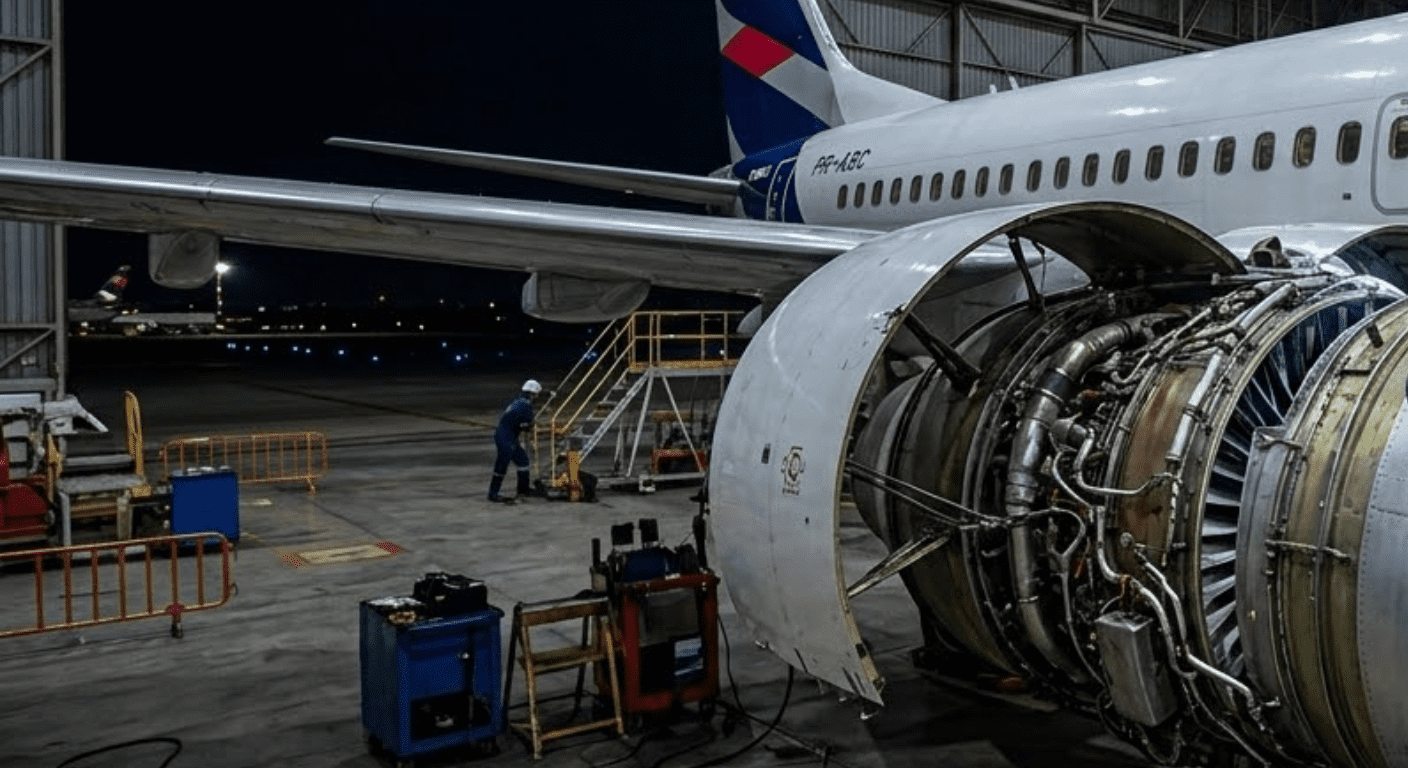
Aviation Safety Depends on Non-Destructive Testing
Aviation is one of the most stringent industrial sectors when it comes to operational safety. Aircraft are designed to operate under severe conditions of load, vibration, pressure variations, and continuous cycles of structural fatigue over thousands of flight hours.
To ensure that all components maintain their structural integrity over time, the aeronautical industry relies heavily on Non-Destructive Testing (END) .
More than just a verification step, ENDs (Non-Destructive Tests) are part of aviation safety culture. From the manufacturing of structures and components to maintenance programs throughout the aircraft’s lifespan, thousands of inspections are carried out to identify potential discontinuities before they evolve into critical failures.
Every safe flight depends on a series of technical inspections that ensure the structural reliability of the aircraft.
Non-Destructive Testing in the Aeronautical Industry
Non-destructive testing methods are used to evaluate the integrity of materials and components without compromising their future use.
In the aeronautical industry, different methods are applied as required by the aircraft manufacturer’s manual. Among the methods used are:
ultrasound
, radiography
, eddy currents
, liquid penetrant testing
, and magnetic particles.
Each method has a specific function within the inspection programs applied in the manufacturing and maintenance of aircraft.
Among these methods, fluorescent penetrant testing and fluorescent magnetic particle testing are widely used for the detection of discontinuities.
Technical rigor and materials control in aviation
The aeronautical sector adopts extremely rigorous criteria for the products used in inspection processes.
For example, the penetrating materials used in these processes must be qualified in the QPL — Qualified Products List.
Only listed materials may be used in certain aircraft inspection processes, ensuring standardization, traceability, and reliability in the results obtained.
Fluorescent penetrant liquid in aircraft inspection
Fluorescent liquid penetrant testing is widely used in the aeronautical industry to identify extremely fine surface discontinuities.
The method is based on the phenomenon of capillarity, allowing the penetrant to penetrate cracks or discontinuities open to the surface. After removing the excess and applying the developer, the retained penetrant returns to the surface, forming indications observed under ultraviolet illumination.
For aeronautical applications, the penetrants, removers, emulsifiers, and developers used must be properly qualified according to the applicable QPL list.
Metal-Chek offers the Sherwin Dubl-Chek line in Brazil, consisting of penetrant testing systems developed to meet the technical requirements of the aeronautical sector.
Fluorescent magnetic particles in ferromagnetic components
Magnetic particle testing is used to inspect components made from ferromagnetic materials.
The method involves magnetizing the component. When there is a surface discontinuity or a discontinuity near the surface, a distortion occurs in the magnetic field, forming a leakage field that attracts the magnetic particles applied to the part.
In the aeronautical industry, the test is typically performed using fluorescent magnetic particles in an oil-based liquid suspension, which provides greater sensitivity in the formation of indications.
In the context of the Metal-Chek line, fluorescent magnetic particles can be used in the aeronautical sector when applied in oil-based suspension, using the Supermagna OMC 10 MMS vehicle .
This combination allows for the proper formation of the suspension for application of the method, in accordance with the technical requirements adopted in aeronautical inspections.
Inspections throughout the aircraft’s lifespan
Non-destructive testing inspections are not limited to aircraft manufacturing.
These methods are part of ongoing maintenance and structural monitoring programs. Throughout the aircraft’s lifespan, components are periodically inspected to identify potential discontinuities caused by:
• structural fatigue
• repetitive load cycles
• vibration
• thermal variations
• severe operating conditions
This continuous monitoring allows for the identification of potentially critical conditions before they evolve into structural failures.
Air safety built into every inspection
Modern aviation safety is the result of a combination of advanced engineering, rigorous procedures, and reliable inspections.
Non-destructive testing is an essential part of this system, allowing the structural integrity of components to be evaluated without compromising their use.
Each inspection performed represents another level of assurance in the integrity of the aircraft, directly contributing to the safety of passengers, crews, and air operations worldwide.
Excellence in products for those seeking reliable results
Metal-Chek provides complete solutions for Non-Destructive Testing, with products developed according to the main ASTM, ISO, ASME, NM and PETROBRAS standards.
Among its solutions are systems for liquid penetrant testing, magnetic particles, and various consumables used in industrial inspections, contributing to consistent results, operational safety, and technical reliability.
Speak with our technical consultants and find the ideal solution for your process.
Visit our blog and check out other technical content.
Discover our complete product line.
