What are non-destructive tests?
Non-destructive testing (END) is fundamental for detecting and evaluating flaws in materials without compromising their structural integrity. These tests identify cracks, pores, and inclusions that can affect the strength and safety of materials.
Metal-Chek is a pioneer in the production of END (Non-Destructive Testing) supplies, focusing on Liquid Penetrant and Magnetic Particle methods. This ensures maximum quality and reliability for your projects.
Non-destructive testing is performed on finished or semi-finished materials to verify the existence (or absence) of discontinuities and/or defects, without altering their physical, chemical, mechanical, or dimensional characteristics and without interfering with their subsequent use. In other words, tests are carried out to attest to the quality of a given part, without damaging or rendering it unusable.
These tests are one of the main tools for quality control of materials and products, helping to ensure quality, reduce costs and prevent accidents.
They are used in manufacturing, construction, assembly, inspection, and maintenance, and are widely applied in welding, castings, forgings, rolled products, plastics, concrete, and other sectors, including Oil & Gas, Power Generation, Petrochemical, Automotive, Aeronautical, Railway, Naval, Steel, Civil Construction, and others.
Non-destructive testing (END) includes methods capable of providing information regarding the defect content of a given product, the technological characteristics of a material, or even the monitoring of in-service degradation of components, equipment, and structures.
The END methods are: ACFM (Alternating Current Field Measurement), Vibration Analysis, Measurement Calibration and Reliability, Dimensional Control, Eddy Currents, Acoustic Emission, Visual Inspection, Leak Testing, Penetrant Testing, Electrochemical Potential Measurement, MFL (Magnetic Flux Leakage), Guided Waves, Magnetic Particles, Instrumented Pig, Thermography, Spot Testing, and Ultrasound.
To obtain satisfactory and valid results, the following items should be considered as fundamental elements of these tests:
- Trained and qualified personnel;
- Procedure for carrying out qualified tests based on clearly defined standards and acceptance criteria;
- Properly calibrated equipment.
In addition to industrial use, the application of END (Non-Destructive Testing) has grown significantly in agriculture and civil construction.
In addition to industrial use, the application of END (Non-Destructive Testing) has grown significantly in agriculture and civil construction.
Non-Destructive Testing by
Penetrant Liquid
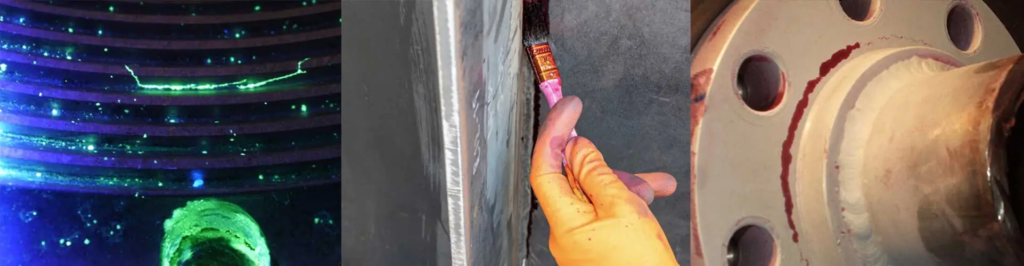
Liquid penetrant testing is considered one of the best methods for detecting surface discontinuities in non-porous materials such as: ferrous and non-ferrous metals, aluminum, metal alloys, ceramics, glass, certain types of plastics, or organo-synthetic materials.
The penetrating liquid is applied with a brush, by spraying with a gun or using an aerosol can, or even by immersing the part in a tank containing the product, and then a certain amount of time is allowed for the penetrating liquid to heal.
Infiltration into discontinued areas is therefore based on the phenomenon of capillarity, which is the ability of a liquid to flow in extremely small areas due to its low surface tension.
Penetration power is a very important characteristic since the sensitivity of the test is extremely dependent on it. This penetrant is removed from the surface by washing with water or removing with solvents.
Non-Destructive Testing by
Magnetic Particles
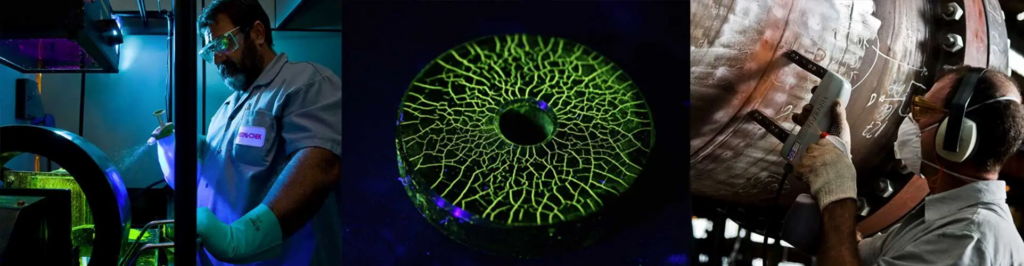
Magnetic Particle testing is used to detect surface and subsurface discontinuities in ferromagnetic materials. Defects such as cracks, weld cracks, cold joints, inclusions, cold shuts, double lamination, lack of penetration, folds, segregations, etc., are detected.
The testing method is based on the generation of a magnetic field that traverses the entire surface of the ferromagnetic material.
The magnetic lines of the induced flux in the material deviate from their path when encountering a surface or subsurface discontinuity, thus creating a region with magnetic polarity that is highly attractive to magnetic particles. When this magnetization is induced, magnetic particles are applied to the part, which in turn will be attracted to the location on the surface containing the discontinuity, thus forming a clear indication of a defect.
The magnetic lines of the induced flux in the material deviate from their path when encountering a surface or subsurface discontinuity, thus creating a region with magnetic polarity that is highly attractive to magnetic particles. When this magnetization is induced, magnetic particles are applied to the part, which in turn will be attracted to the location on the surface containing the discontinuity, thus forming a clear indication of a defect.
Typical examples of applications include ferritic steel castings, forgings, rolled products, extrusions, welds, machined or heat-treated parts (nuts and bolts), grinding cracks, and many other applications in ferrous materials.
When detecting discontinuities, it is important that they are positioned in such a way that they are “intercepted” or “crossed” by the lines of induced magnetic flux; consequently, the part must be magnetized in at least two directions 90° out of phase. To perform this test, electromagnets, the well-known yokes – portable machines – or stationary magnetization equipment for serial or standardized tests
are used.
