
Do you know what makes a penetrating liquid effective?
When it comes to inspecting materials using the liquid penetrant method, the efficiency of the product used plays a crucial role in the success of the operation. But what makes a penetrant liquid truly effective?
Metal-Chek is recognized for providing innovative solutions to industry, especially in the field of materials inspection. Among our flagship products, Metal-Chek VP-30 stands out as a high-quality penetrant liquid, specially designed to detect surface discontinuities in non-porous materials. In this article, we will explore the main characteristics and benefits of Metal-Chek VP-30, as well as explain what makes this product efficient in the materials inspection process.
Next, we will explore the key factors that make a penetrating liquid effective, and how this applies to our Metal-Chek VP-30 Visible Penetrant Liquid product.
1. Penetration Capacity
The main function of a penetrant liquid is to penetrate surface flaws in the material in question. Therefore, the product’s ability to enter cracks and discontinuities of different sizes is fundamental. This means that the liquid needs to have an adequate viscosity, not too thick so that it can quickly infiltrate small openings, but also not so thin that it loses effectiveness. Metal-Chek VP-30 was formulated with a viscosity of 7.40 ± 0.74 cSt at 38°C, allowing it to effectively penetrate the most difficult-to-access flaws without losing visibility and durability of the indications.
2. Surface Tension and Spreading
The surface tension of a penetrant liquid is a determining factor in its efficiency. The higher the surface tension, the more difficult it is for the liquid to spread and penetrate the cracks. On the other hand, if the surface tension is too low, the liquid may spread excessively, failing to reach the flaws and creating problems with the results. Metal-Chek VP-30 is designed with a balanced surface tension, allowing it to spread evenly over the surface of the part, adhering well to the cracks and ensuring good visualization after development.
3. Visibility of Indications
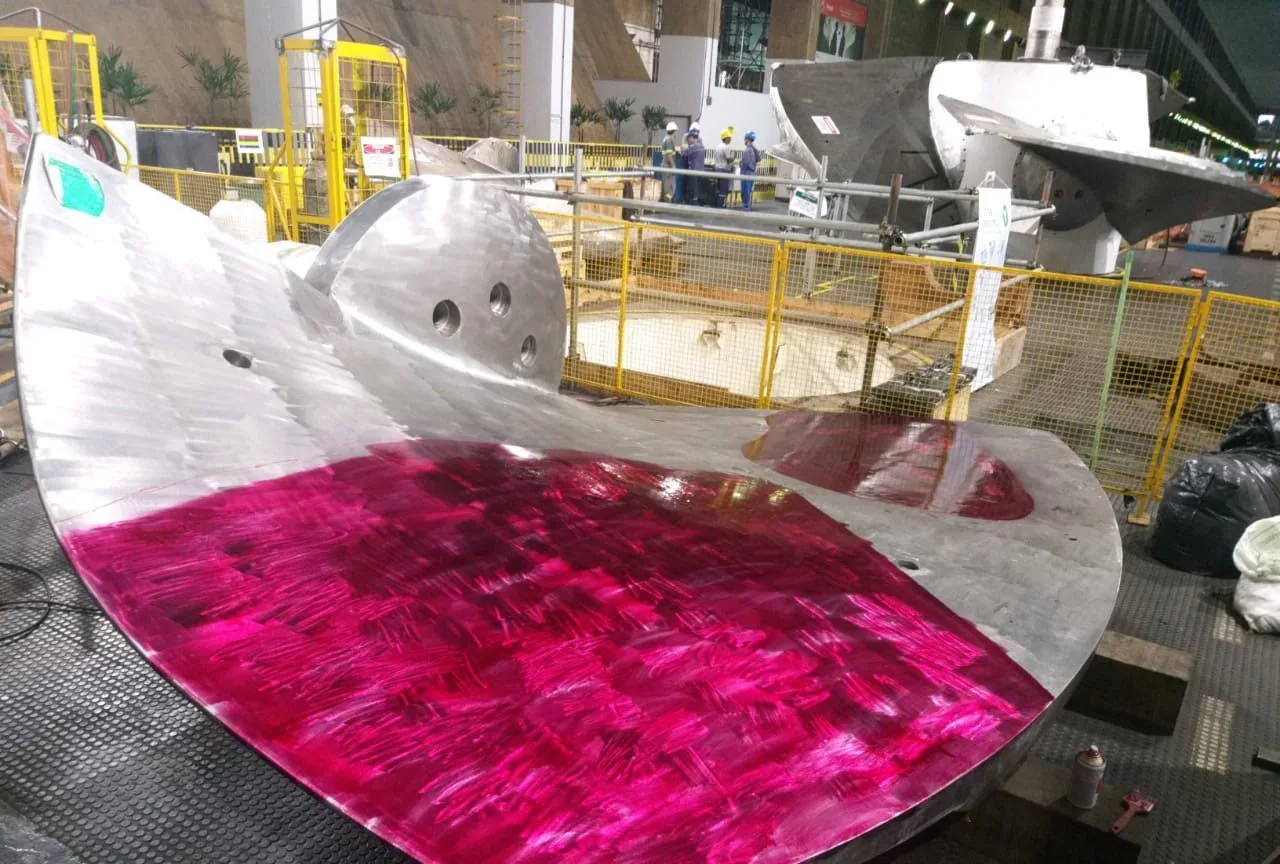
After the liquid penetrates the flaws, the next step is to make these flaws visible to inspectors. This is done using a developer, which causes the liquid collected in the cracks to stand out on the material’s surface. The color of the penetrant plays a crucial role in the visibility of the flaws, as the color needs to contrast with the material’s surface to ensure that the flaws are easily identified. Metal-Chek VP-30 is a red-colored visible penetrant, ensuring a strong distinction between the penetrant in the flaws and the background of the part, facilitating inspection.
4. Ease of Removal
Another crucial aspect of an efficient penetrant liquid is its ease of removal. After the appropriate penetration time, the excess penetrant needs to be removed without leaving residues that could interfere with subsequent analysis. Penetrant removal is usually done with water or special solvents. Metal-Chek VP-30 is water-washable, meaning it can be easily removed from the surface, leaving the inspection area clean and residue-free. This facilitates not only inspection but also the maintenance of parts.
5. Durability of Indications
For the inspection process to be effective, the indications of defects need to be visible for an adequate time after the developer is applied. The durability of the indications refers to the length of time the penetrant, now revealed, remains visible to the inspector. Metal-Chek VP-30 was formulated to ensure that the indicated defects remain visible for longer, with minimal fading, increasing the reliability of the inspection process.
6. Material Compatibility
The compatibility of the penetrant liquid with the materials being inspected is essential to ensure that the process does not damage the material and that the physical and chemical properties of the product are not compromised. Metal-Chek VP-30 is compatible with a wide range of materials, such as ferrous and non-ferrous metals, ceramics, plastics, and glass, allowing its use in various industries, from the automotive sector to aerospace and civil construction.
7. Temperature Range
The temperature of the surfaces to be inspected can vary considerably in industrial environments. An efficient penetrant liquid must be able to operate in a wide temperature range to ensure it functions correctly regardless of the conditions. The Metal-Chek VP-30 has an operating temperature range between 10 and 52 °C, meaning it can be used in a variety of environmental conditions without compromising its performance.
8. Compliance with Standards
Finally, compliance with industry standards is also an important factor in ensuring the efficiency of the penetrant liquid. Metal-Chek VP-30 meets a number of international standards, including ISO 3452-2, AMS 2644 and ASTM E-1417, which ensures that it has been tested and approved for use in various critical industries and processes. This guarantees not only the product’s efficiency but also its reliability and safety in inspection operations.
Applications and Benefits
It helped me understand a little more about the characteristics that lead to effectiveness during inspection processes. It is the ideal product for inspecting components during manufacturing and maintenance stages, ensuring that parts meet the required quality standards.
Furthermore, its use in ferrous and non-ferrous metals, ceramics, glass, and plastics expands the product’s versatility, making it an indispensable choice for industries that demand rigorous quality control, such as the automotive, aeronautical, metallurgical, and construction industries.
And how do I use Metal-Chek VP-30 Visible Penetrant Testing Liquid?
The application process for Metal-Chek VP-30 follows a set of simple and well-defined steps to ensure maximum effectiveness in fault detection. Below, we explain the recommended procedure:
- Pre-cleaning : Before applying the penetrant, the material surface must be cleaned of oil, grease, paint, or any other residue that may interfere with the capillary action of the liquid. For this, the use of Metal-Chek solvent removers, such as Metal-Chek E 59 or R 501 , is recommended.
- Penetrant Application : Metal-Chek VP-30 should be applied to a dry and clean surface by spraying. The recommended penetration time is 10 minutes, but may vary depending on the nature of the defect and the complexity of the test.
- Excess Removal : Excess penetrant should be removed with water, using a pressure of up to 40 psi and a temperature between 10 and 38 °C. Removal should be done carefully to avoid excessive washing.
- Drying : After removing the excess, the piece can be left to air dry or dried in a temperature-controlled oven.
- Development : The non-aqueous Metal-Chek D-70 or D-702 developer should be applied in a thin, even layer over the area of interest to allow visualization of the defects.
- Inspection : After applying the developer, the inspection should be carried out under suitable light to identify the defects indicated by the contrasting red coloration.
So far, it’s clear that our product offers an efficient and practical solution for detecting surface discontinuities, with the advantage of being easily removed with water and guaranteeing a clear visualization of the flaws. Its wide operating temperature range, high durability of indications, and compatibility with different materials make this penetrant a reliable choice for high-precision inspections.
With the right product, your company can perform faster, more reliable, and more economical inspections, while maintaining the quality and safety standards essential for success in critical industrial processes. For more information about the Metal-Chek VP-30 , contact our team and discover how this product can add value to your operation.
